Salesforce Agentforce Adoption Guide: Readiness Playbook for Service Leaders
Shravya Martha
Mar 09, 2026
Ticket volumes are rising. Budgets are flat. Agents are burning out.
Traditional service models built for phone-first call centers and manual ticket handling are struggling to keep up with modern expectations for instant, consistent, omnichannel support.
Salesforce Agentforce introduces a fundamentally different model: AI agents that can sense customer intent, reason through context, and act autonomously within your CRM resolving a significant share of repetitive tier-1 workload without human intervention.
But Agentforce is not a switch you flip. It delivers results only when your data, processes, governance, and operating model are ready.
This playbook helps service and CX leaders assess whether their organization is prepared — and what must be true before adopting AI-driven service at scale.
The Breaking Point: Why Traditional Service Models Are Failing
Most enterprise support organizations are running on a model designed for a different era when volume was manageable, channels were limited, and processes were largely manual.
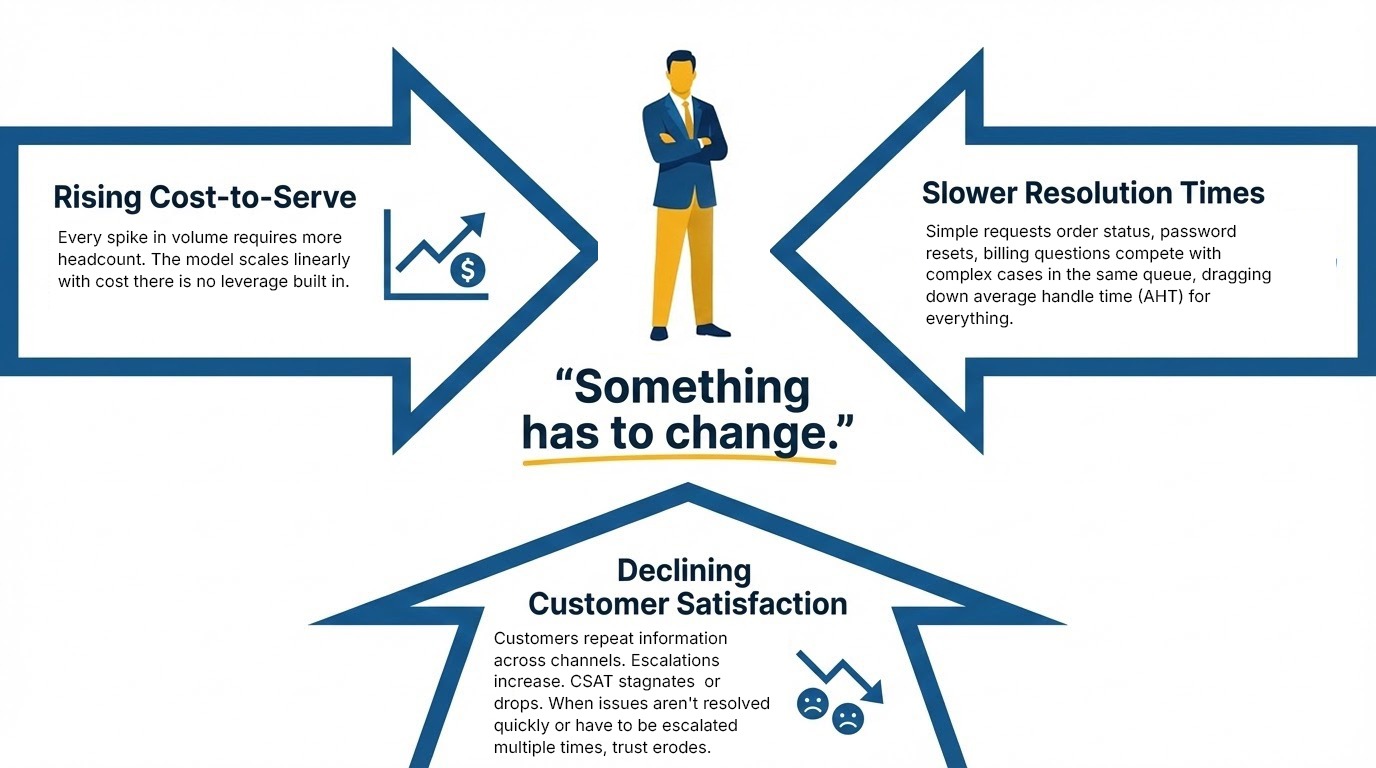
Agents swivel between systems, re-enter customer data, search static knowledge bases, and handle repetitive tier-1 requests manually. As organizations scale, three systemic problems emerge:
- Rising Cost-to-Serve: Every spike in volume requires more headcount. The model scales linearly with cost; there is no leverage built in.
- Slower Resolution Times: Simple requests order status, password resets, billing questions compete with complex cases in the same queue, dragging down average handle time (AHT) for everything.
- Declining Customer Satisfaction: Customers repeat information across channels. Escalations increase. CSAT stagnates or drops. When issues aren't resolved quickly or have to be escalated multiple times, trust erodes.
- The human impact is equally real: burnout, fatigue from constant context switching, and high turnover rates are now endemic in enterprise support organizations.
The question is no longer whether automation is needed. The question is how far automation should go.
What Actually Changes with Salesforce Agentforce?
Agentforce is Salesforce's AI-native service layer designed to shift support from reactive ticket handling to autonomous resolution.
Unlike traditional bots that follow rigid scripts, Agentforce agents:
- Understand context across channels
- Retrieve real-time CRM and Data Cloud data
- Apply multi-step reasoning through Salesforce's Atlas Reasoning Engine
- Take action within defined guardrails
- Escalate only when human judgment is required
This represents a structural shift in how service operates:
- Traditional Model: Humans handle everything and occasionally use automation tools.
- Agentforce Model: AI handles the frontline. Humans focus on complex, high-empathy cases.
Instead of human agents handling everything and occasionally using automation tools, AI agents handle the frontline and escalate to humans only when empathy, judgment, or complexity demands it.
Agentforce 2.0: Smarter, Faster, More Connected
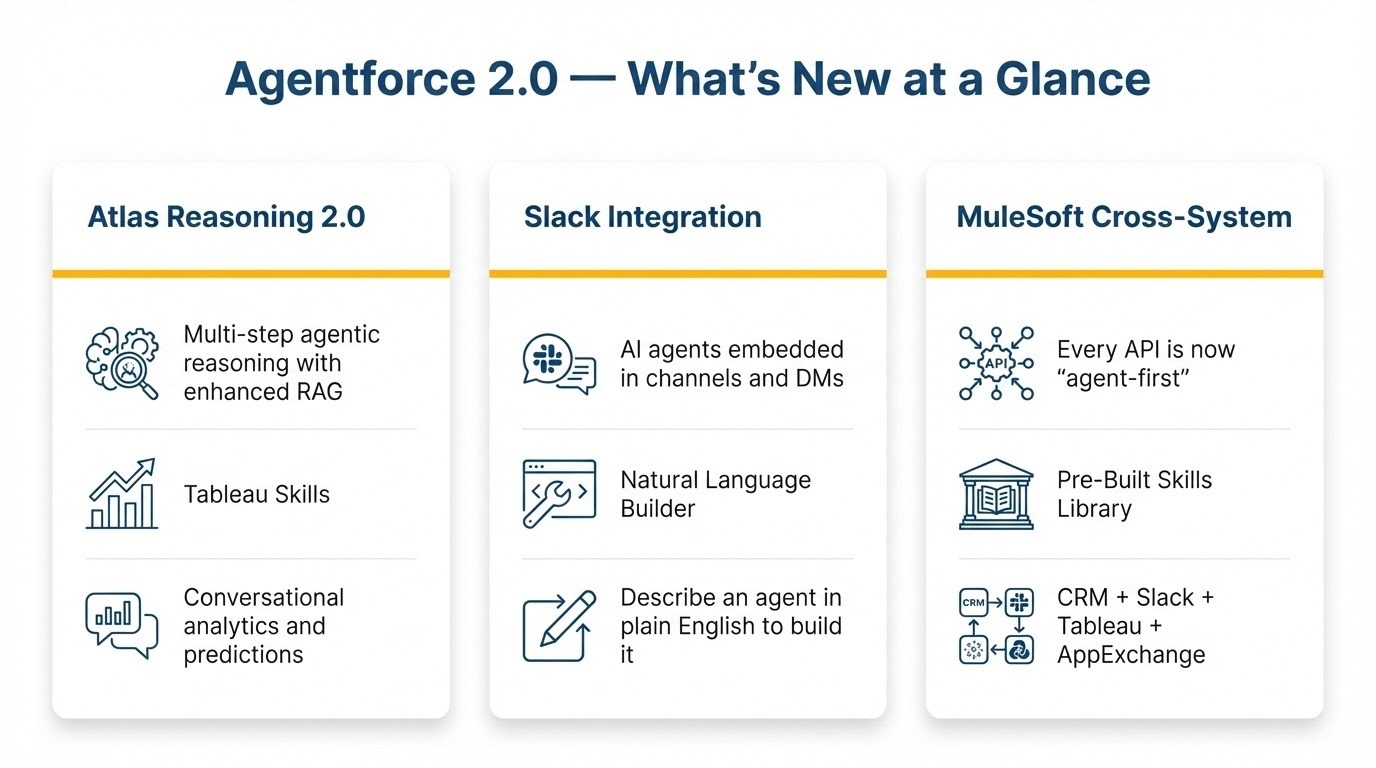
Salesforce's Agentforce 2.0 release generally available since February 2025 . significantly expanded the platform's capabilities, transforming Agentforce from a conversational assistant into a scalable digital workforce.
Enhanced Atlas Reasoning Engine
The Atlas Reasoning Engine is the "brain" behind Agentforce. In version 2.0, it handles complex, multi-layered queries by analyzing data from multiple sources, checking its own reasoning through an iterative "agentic loop," and delivering well-researched responses all without custom code.
A simple question like "What's the status of my order?" uses basic reasoning for a rapid response. A layered question like "What would be the right investment vehicle for my child's college fund based on my income and risk preferences?" triggers enhanced reasoning with advanced data retrievers and metadata enrichment.
Enhanced RAG (Retrieval Augmented Generation) in Data Cloud now enriches retrieved data chunks with business-specific metadata, improving accuracy and relevance without additional configuration.
Slack Integration: AI in the Flow of Work
Agentforce 2.0 agents operate directly within Slack channels. Employees interact with AI agents via direct mentions or the Agentforce Hub, making digital labor part of everyday team workflows. Pre-built Slack Actions like "Create Canvas" or "Message Channel" allow rapid deployment of agents that summarize projects, update stakeholders, or route decisions. Slack Enterprise Search also allows Agentforce to draw from conversational data across DMs, channels, and Canvases to enhance response relevancy.
MuleSoft Integration: Cross-System Workflows
The new MuleSoft Topic Center and API Catalog make every API "agent-first" by default. Teams can connect Agentforce to any business system through low-code workflows, eliminating the data silos that typically stall AI deployments.
Tableau Skills: Conversational Analytics
New Tableau Topics and Actions deliver data visualizations and predictions directly within agent responses using Tableau Semantics lowering the barrier to data access for non-technical users.
Natural Language Agent Builder
Creating new agents no longer requires deep technical expertise. The enhanced Agent Builder interprets natural language instructions (e.g., "Onboard New Product Managers") to auto-generate agents that combine pre-built skills with custom logic.
Pre-Built Skills Library
A significantly expanded library of pre-built skills spans CRM, Slack, Tableau, and partner-developed skills via AppExchange — enabling rapid deployment across sales, service, marketing, and commerce.
These advancements reduce implementation friction but they do not eliminate the need for readiness.
Agentforce vs. Traditional Support: What Service Leaders Should Compare
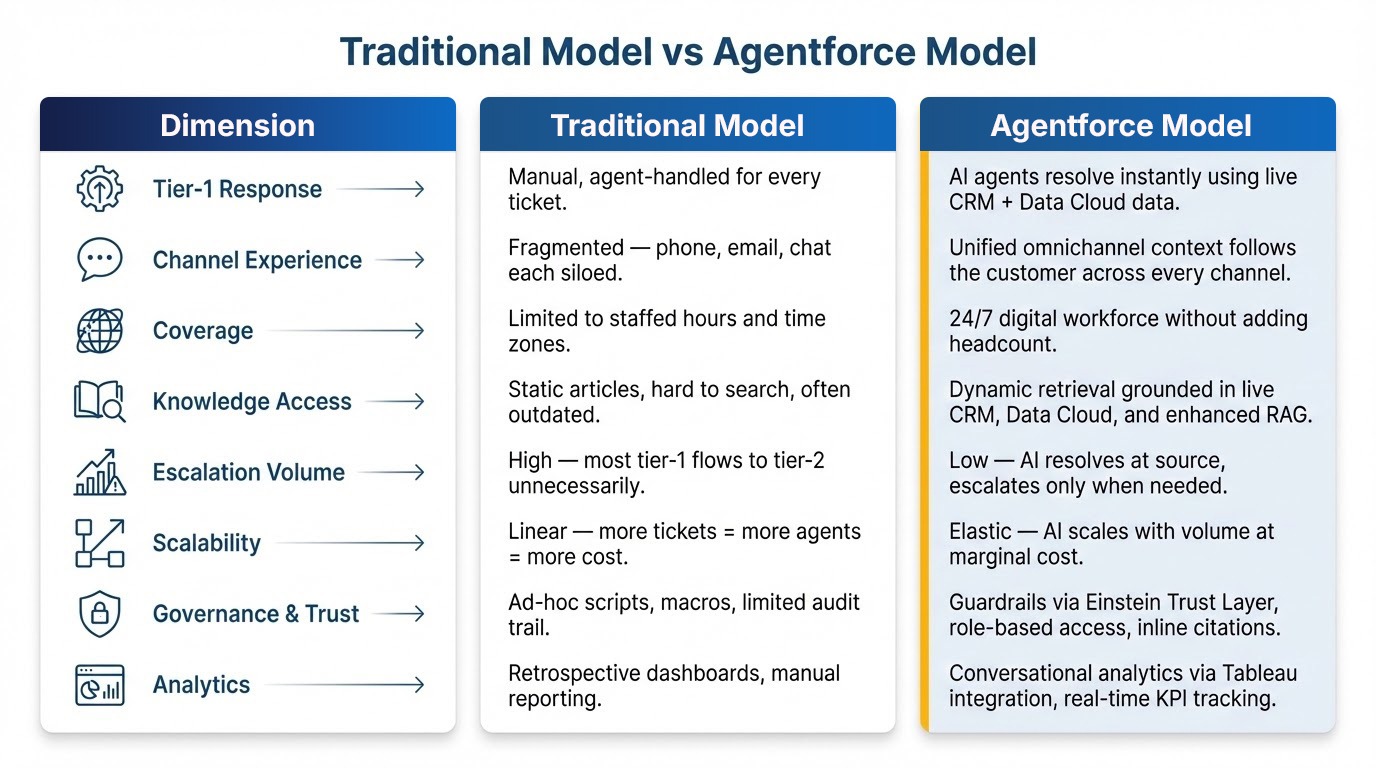
This is not a feature comparison. It's an operating model comparison. The following table highlights the operational differences that matter most to service and CX leaders:
Dimension | Traditional Model | Agentforce model |
|---|---|---|
Tier-1 Response | Manual, agent-handled for every ticket | AI agents resolve instantly using live CRM + Data Cloud data |
Channel Experience | Fragmented — phone, email, chat each siloed | Unified omnichannel context follows the customer across every channel |
Coverage | Limited to staffed hours and time zones | 24/7 digital workforce without adding headcount |
Knowledge Access | Static articles, hard to search, often outdated | Dynamic retrieval grounded in live CRM, Data Cloud, and enhanced RAG |
Escalation Volume | High — most tier-1 flows to tier-2 unnecessarily | Low AI resolves at source, escalates only when needed |
Scalability | Linear — more tickets = more agents = more cost | Elastic AI scales with volume at marginal cost |
| Governance & Trust | Ad-hoc scripts, macros, limited audit trail | Guardrails via Einstein Trust Layer, role-based access, inline citations |
| Analytics | Retrospective dashboards, manual reporting | Retrospective dashboards, manual reporting |
The Jade Agentforce Readiness Framework
Before investing in AI agents, service leaders must assess whether their foundation supports autonomous resolution. Jade Global recommends evaluating readiness across five dimensions. Use this scorecard in your next leadership meeting.
- Data Foundation
Is your customer data centralized and accessible?
Agentforce thrives on structured, unified data from Salesforce CRM and Data Cloud. AI agents are only as reliable as the data they access.
If critical customer data sits in spreadsheets, email threads, or disconnected systems, AI agents will struggle to deliver accurate, safe responses.
Readiness Level | What It Looks Like |
|---|---|
🔴 Not there yet | Key data in spreadsheets, multiple CRMs, or email |
🟡 In progress | Consolidating into Salesforce; some integrations live |
🟢 Strong | Most interaction history and customer data lives in Salesforce + connected systems |
- High-Volume, Well-Defined Use Cases
Do you have repeatable tier-1 flows ready for automation?
Agentforce delivers strongest ROI when applied to tasks with clear logic, high frequency, and low ambiguity: order tracking, returns, billing queries, password resets, service renewals, warranty questions.
Document your top 5–10 repetitive tier-1 flows before deployment
Readiness Level | What It Looks Like |
|---|---|
🔴 Not there yet | Most support requests are complex, nuanced, or undefined |
🟡 In progress | Some repeatable use cases identified but not documented |
🟢 Strong | Top 5–10 tier-1 use cases documented with clear logic and resolution paths |
- Cross-Functional Alignment
Are support, IT, and compliance aligned on automation goals?
AAI adoption requires coordination between customer support, IT, compliance, and data governance. Technology cannot compensate for organizational misalignment.
Readiness Level | What It Looks Like |
|---|---|
🔴 Not there yet | No cross-functional alignment on AI goals |
🟡 In progress | IT and support have discussed automation; no formal plan |
🟢 Strong | Shared roadmap with defined roles, escalation rules, and governance |
- Omnichannel Strategy
Is omnichannel support critical for your business?
Agentforce excels at handling context-rich conversations across platforms. If channels operate in silos, Agentforce will expose that fragmentation. AI thrives in environments where customer context flows seamlessly across touchpoints.
Readiness Level | What It Looks Like |
|---|---|
🔴 Not there yet | Single-channel support (phone only or email only) |
🟡 In progress | Multiple channels live but context doesn't carry over |
🟢 Strong | Active omnichannel strategy; ready to unify with AI |
- Executive Sponsorship
Do you have executive buy-in for AI transformation?
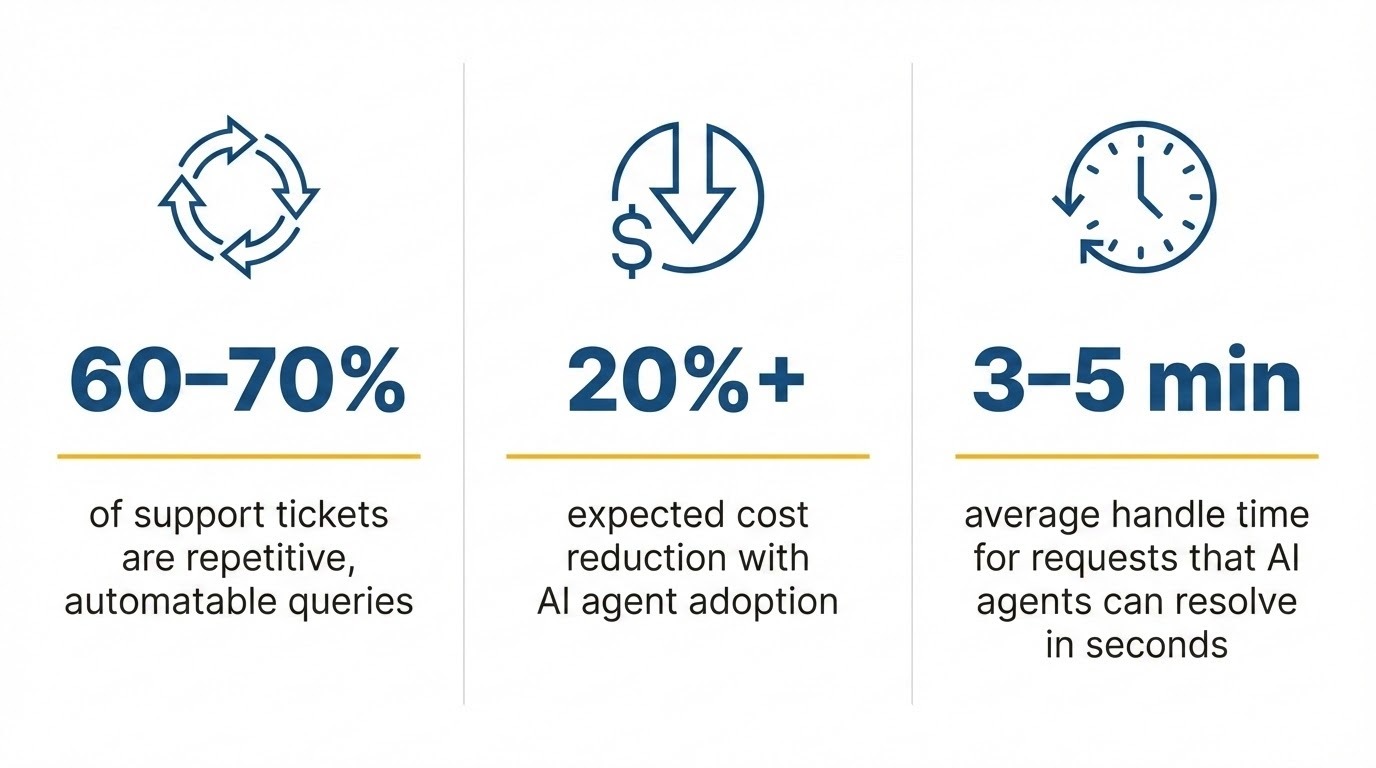
Agentforce delivers measurable ROI service teams using AI agents can expect cost and resolution time improvements averaging 20%+. But executive sponsorship is essential to fund pilots, manage change, and scale beyond a proof-of-concept.
AI service transformation is not a side project. It requires funding, KPIs, and visible executive ownership.
Readiness Level | What It Looks Like |
|---|---|
🔴 Not there yet | No executive sponsor for AI in service |
🟡 In progress | Executive interest but no budget or formal initiative |
🟢 Strong | Funded initiative with executive champion and clear KPIs |
Real Impact: How Jade Global Delivered Agentforce Results
Jade Global has been a trusted Salesforce Partner for over a decade and was among the early implementers of Agentforce-driven AI agents for enterprise service and sales organizations.
Case Spotlight: AI-Powered Lead Engagement for a Global SaaS Provider
Challenge: A cloud-based CRM and ITSM provider with 70,000+ customers faced critical bottlenecks — SDRs spent over 70% of their time manually qualifying inbound requests, demo request forms caused high drop-off, and agents context-switched across Salesforce, email, and other tools.
Solution: Jade Global deployed an autonomous digital SDR powered by Agentforce, utilizing the Atlas Reasoning Engine for complex intent-based decision-making, dynamic context-switching across languages and regions, and seamless Salesforce-native operation.
Results: The following results achieved:
- 80% of lead qualification automated freeing SDRs to focus on high-value conversations
- 70% reduction in manual effort across the pre-sales journey
- Eliminated data silos through unified Salesforce-native agent interactions
- Scalable, multilingual engagement supporting global expansion
This is what AI-native service transformation looks like in practice.
Why Listen to Jade on Agentforce?
The readiness criteria and recommendations in this playbook come from hands-on experience across multiple Agentforce implementations not theory.
- Decade-long Salesforce partnership with a dedicated Agentforce consulting practice
- 12+ enterprise-grade AI solutions built across industries including SaaS, Hi-tech, and Manufacturing
- Early Agentforce adopter among the first SI partners to deliver production Agentforce deployments
- End-to-end capability from readiness assessment and data architecture through pilot design, go-live, and adoption
- Dreamforce thought leadership actively shaping the Agentforce conversation with Salesforce and the broader ecosystem
Ready to Assess Your Agentforce Readiness?
If this playbook surfaced gaps or confirmed readiness Jade Global's Agentforce specialists can help with a structured, no-obligation review.
What you get in a 60-minute Agentforce Readiness Review:
- Assessment of your current service model, data maturity, and automation potential
- Identification of 2–3 highest-impact Agentforce use cases for your business
- A tailored readiness roadmap with clear next steps and timeline
- Honest guidance on where to start pilot, foundation-building, or full rollout
Request Your Agentforce Readiness Review Now!
No spam. A Jade Global consultant will review your current support model and share personalized recommendations.
Subscribe to our Technology Insights
Popular Posts




About the Author

How Can We Help You?
Related Posts