
What is Salesforce Data 360, and How Is It a Game-Changer for Unified Customer Insights
Kalash Deep
Nov 24, 2025
Summary: In an era where fragmented data hinders customer understanding, Salesforce Data 360, formerly known as Salesforce Data Cloud and reintroduced at Dreamforce 2025, emerges as a game-changer for unified, AI-driven insights. Built natively within the Salesforce ecosystem, it connects data from CRM, ERP, marketing, and external platforms into a single, trusted customer profile, enabling real-time intelligence across sales, service, and marketing.
With features like zero-copy architecture, real-time ingestion, and Einstein AI integration, Data 360 eliminates silos, strengthens governance, and empowers teams to deliver personalized, data-driven engagement at scale. Its applications span industries from personalized retail journeys and patient-centric healthcare to predictive service management in high-tech and risk assessment in financial services.
Jade Global’s Salesforce Data 360 Consulting Services help enterprises accelerate adoption by aligning data architecture, governance, and AI readiness. By leveraging prebuilt connectors and deep Salesforce expertise, Jade enables organizations to turn disconnected data into actionable intelligence that drives measurable business growth.
In today’s AI-driven world, every enterprise aims to understand customers deeply, yet most struggle with fragmented, disconnected data. Salesforce Data 360 bridges that gap. By unifying all customer data in real time and making it actionable across every business function, it becomes the foundation for truly intelligent customer engagement.
What is Salesforce Data 360?
At Dreamforce 2025, Salesforce reintroduced Data Cloud as Salesforce Data 360, emphasizing its evolution into a real-time, AI-native platform that seamlessly integrates with Einstein Copilot and Agentforce. Key announcements included advancements in zero-copy data federation, metadata harmonization across clouds, and native AI activation, positioning Data 360 as the central intelligence layer powering every Salesforce experience.
Salesforce Data 360 is an enterprise-grade, real-time data platform built natively within the Salesforce, Inc. ecosystem. It connects data from any source, CRM, ERP, marketing platforms, analytics tools, or third-party apps and harmonises it into a single, trusted customer profile.
Unlike traditional data warehouses that store information in silos, Salesforce Data 360 creates a dynamic 360-degree view of every customer. It continuously ingests structured and unstructured data, performs identity resolution to merge multiple records, and ensures your teams always have access to accurate, unified insights.
With Salesforce’s metadata framework, this unified profile becomes instantly usable across Salesforce Sales Cloud, Service Cloud, Marketing Cloud, and Commerce Cloud, enabling real-time activation and personalisation without data duplication.
Another advantage is its zero-copy architecture, which enables enterprises to connect directly to external data lakes such as Snowflake, Databricks, or AWS S3 without moving data. This not only saves time and storage costs but also improves data security and governance.
Salesforce Data 360 is also AI-ready by design. It powers predictive analytics, personalised recommendations, and generative insights through Einstein AI and Agentforce, Salesforce’s conversational AI layer. By combining governed data with AI capabilities, businesses can drive contextual, trustworthy engagement at scale.
In essence, Salesforce Data 360 transforms customer data into a living asset, a single, always-on intelligence layer that fuels every decision, every workflow, and every customer interaction.
Reimagining Customer Insights with Salesforce Data 360
Salesforce Data 360 is redefining how enterprises unlock, understand, and act on customer intelligence. Breaking down silos between marketing, sales, service, and commerce enables every team to operate from a single, continuously updated source of truth.
Here’s what makes it revolutionary:
- Real-time customer context: Every interaction from a website visit to a service ticket updates customer profiles, ensuring your teams always act on the latest information.
- AI-driven personalization at scale: Powered by Einstein and Agentforce, the Data 360 transforms insights into next-best actions, creating hyper-personalized journeys that boost engagement and loyalty.
- Seamless data interoperability: Its zero-copy architecture lets organizations unify and query external data (e.g., Snowflake, AWS, Azure) without duplication, delivering both speed and governance.
- Cross-functional intelligence: Marketers, sellers, and service teams gain a unified understanding of every customer, eliminating data silos and guesswork.
- Trust and compliance: Built-in governance and consent management ensure customer data is used ethically and transparently, reinforcing long-term trust.
Ultimately, Salesforce Data 360 turns fragmented enterprise data into connected customer intelligence, enabling proactive engagement, more intelligent decisions, and measurable ROI across every channel.
Salesforce Data 360 Architecture
Salesforce Data 360 is built on a multi-layered architecture that unifies, harmonizes, and activates customer data in real time. It enables enterprises to break down silos across CRM and non-CRM systems while maintaining security, scalability, and compliance.
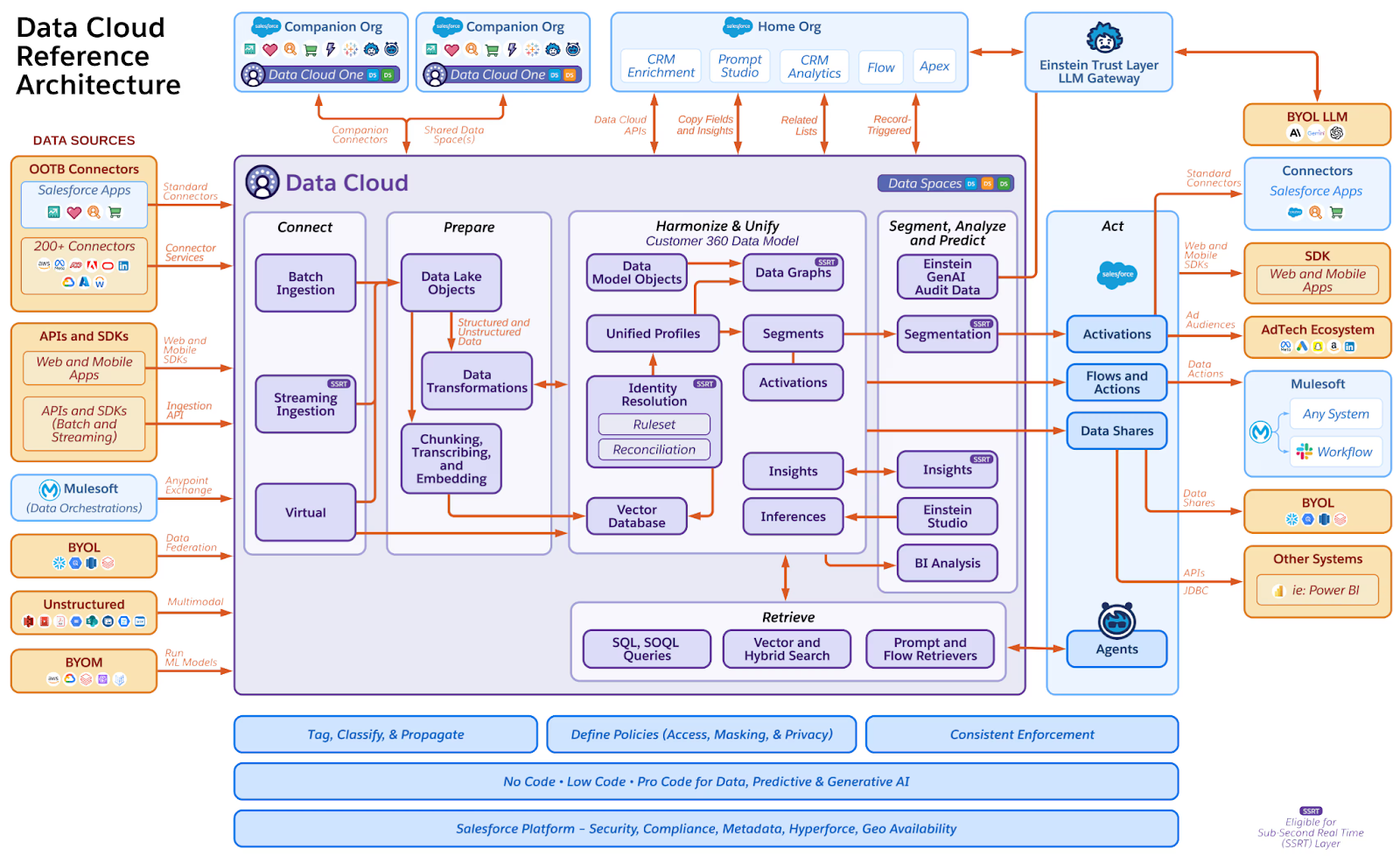
- Data Source Objects (DSOs): Ingest data from Salesforce apps and external systems through batch, streaming, or APIs to ensure continuous synchronization.
- Data Lake Objects (DLOs): Cleanse, enrich, and standardize datasets into a harmonized model ready for analytics and AI.
- Data Model Objects (DMOs): Create unified customer and business profiles by resolving identities and mapping relationships for a 360° view.
Above these layers, core services like identity resolution, segmentation, calculated insights, and activation transform data into actionable intelligence. Seamless integration with Salesforce Flows, Einstein AI, and Tableau enables real-time automation and decision-making.
With zero-copy architecture, data stays in its original storage (Snowflake, AWS, or Azure) while remaining queryable, delivering faster insights, scalable personalization, and strong compliance from a single, AI-ready data foundation.
Key Features of Salesforce Data 360
Salesforce Data 360 unifies fragmented data and powers real-time, AI-driven insights across the enterprise, bridging structured and unstructured sources to create a single, trusted view of every customer.
- Real-Time Ingestion: Continuously collects data from CRM, ERP, IoT, and third-party systems for instant visibility and action.
- Identity Resolution: Merges records across systems to create a single source of truth for every customer.
- Zero-Copy Architecture: Connects directly to data lakes such as Snowflake, AWS, or Azure without duplication, ensuring security and performance.
- Intelligent Segmentation & Activation: Builds dynamic audiences and activates personalized campaigns or workflows across Salesforce Clouds.
- Einstein AI Insights: Delivers predictive analytics and next-best actions for more intelligent engagement.
- Governance & Compliance: Ensures compliance with GDPR, HIPAA, and CCPA through encryption, consent management, and audit controls.
Together, these capabilities enable personalized, connected, and AI-powered customer experiences built on trusted data. Below are the most advanced features
Intelligent Context
Intelligent Context enables the secure processing of records and documents, enabling insights to be derived quickly and accurately while maintaining compliance with data regulations.
By connecting structured data (such as transactions or preferences) with unstructured content (such as emails, documents, or notes), AI models such as Einstein and Agentforce can generate context-aware, reliable outputs that drive smarter decision-making.
Data360 Clean Rooms
Data360 Clean Rooms enable organizations to securely collaborate on shared data, allowing insights to be analyzed and activated without exposing or duplicating sensitive information while ensuring compliance with privacy regulations.
Built on Zero-Copy Architecture, they provide a governed environment for safe cross-organizational collaboration, enabling teams to unlock insights and activate campaigns with confidence.
Salesforce Data 360 Real-World Use Cases
Salesforce Data 360 empowers organizations across industries to unify disconnected data, unlock deeper insights, and deliver AI-driven, real-time experiences. Below are detailed examples of how different sectors leverage their capabilities to drive measurable business outcomes.
Salesforce Data 360 Use Cases for Retail: Unified Customer Journeys and Personalized Promotions
Retailers use Salesforce Data 360 to unify data from point-of-sale (POS) systems, eCommerce platforms, mobile apps, and loyalty programs, creating a single, 360° customer profile.
By connecting behavioral and transactional data, marketing teams can:
- Deliver hyper-personalized offers based on purchase history, preferences, and location.
- Trigger real-time promotions when customers browse or abandon carts.
- Identify high-value segments for loyalty rewards and retention campaigns.
The result is increased conversion rates, higher basket sizes, and improved customer lifetime value (CLV), all driven by real-time data.
Salesforce Data 360 Use Cases for Healthcare and Life Sciences: Patient-Centered Care and Operational Efficiency
In healthcare, Salesforce Data 360 bridges data from Electronic Medical Records (EMR), appointment scheduling systems, patient portals, and contact centers.
This unified data foundation helps providers and payers:
- Gain 360° visibility into patient journeys from scheduling to discharge.
- Enable personalized outreach, such as wellness reminders or treatment follow-ups.
- Identify care gaps and service bottlenecks using real-time insights.
- With integrated compliance features for HIPAA, GDPR, and CCPA, organizations can improve patient outcomes while maintaining trust and regulatory readiness.
Salesforce Data 360 Use Cases for High-Tech: Customer Retention and Predictive Service Management
High-tech companies often manage vast amounts of customer, product, and subscription data across multiple systems. Salesforce Data 360 helps unify data from product usage logs, CRM records, service tickets, and renewal databases to enable:
- Churn prediction through behavioral and usage analysis.
- Automated renewal workflows, driven by engagement scores and product activity.
- Cross-sell and upsell recommendations powered by Einstein AI.
This ensures proactive engagement, reduces churn, and accelerates revenue lifecycle management (RLM), crucial for SaaS and technology firms operating on subscription models.
Salesforce Data 360 Use Cases for Financial Services: Real-Time Risk Assessment and Relationship Insights
Banks, insurance providers, and fintech companies use Data 360 to connect core banking, CRM, KYC, and transaction systems. This enables:
- Real-time fraud detection through pattern analysis and anomaly alerts.
- Comprehensive customer profiles that blend financial, demographic, and behavioral data.
- Personalized financial advice or cross-product recommendations (e.g., offering credit cards to high-saving clients).
- Data 360 identity resolution ensures accurate client records across business units, while Einstein AI delivers predictive insights for credit scoring, risk mitigation, and customer growth strategies.
Salesforce Data 360 Use Cases for Manufacturing: Predictive Maintenance and Dealer Experience Optimization
Manufacturers leverage Salesforce Data 360 to integrate IoT sensor data, dealer management systems, service requests, and warranty information into a unified hub.
Key use cases include:
- Predictive maintenance detects equipment issues before they cause downtime.
- Proactive service scheduling and warranty claim automation.
- Dealer performance analytics to optimize inventory, parts availability, and service quality.
This connected ecosystem leads to fewer disruptions, improved customer satisfaction, and reduced operational costs.
Cross-Industry Impact: From Insight to Action
Across every sector, Salesforce Data 360 delivers three universal advantages:
- Real-Time decision-making: Empower teams with instant insights using AI and analytics.
- Personalized experiences: Engage every customer, patient, or partner with relevant, timely communication.
- Measurable ROI: Reduce operational inefficiencies, boost retention, and accelerate revenue growth through data-driven strategies.
How to unlock the power of Salesforce Data 360
Salesforce Data 360 Implementation requires more than technology; it demands a clear data strategy, robust integration, and governance to ensure that insights are accurate, actionable, and compliant. Many enterprises face challenges such as fragmented systems, poor data quality, and insufficient AI readiness that prevent them from realizing the full value of their customer data. This is where expert consulting becomes essential.
Jade Global’s Salesforce Data 360 Consulting Services help organizations overcome these challenges by aligning business goals with the right data architecture and activation strategy. Our experts bring deep experience across data integration, identity resolution, governance, and AI enablement, ensuring that your data ecosystem is both unified and intelligent.
With Jade, enterprises can accelerate implementation, improve data trust, and turn disconnected information into real-time, AI-ready insights that drive smarter decisions and measurable growth.
Conclusion
In the era of AI, enterprises can’t afford fragmented data. Salesforce Data 360 delivers the intelligence layer every business needs, unifying customer data, enabling real-time decisions, and powering personalized engagement across every channel.
With Jade Global’s Salesforce Data 360 expertise, organizations can accelerate data unification, governance, and AI readiness, turning data into a strategic advantage that drives impact across sales, service, and marketing.
FAQs
Q1. What is the Difference Between Salesforce CDP and Data 360
Salesforce CDP (Customer Data Platform) is a marketing-focused tool that consolidates customer data from multiple sources to create unified profiles and actionable segments. It empowers marketers to deliver targeted, personalized campaigns. The newer Salesforce Data 360 expands this vision across all business functions, integrating AI and real-time intelligence into every workflow. While both platforms unify customer data, CDP is marketing-centric, focusing on segmentation and campaign activation, whereas Data 360 is enterprise-wide.
Q2. Is Salesforce Data 360 the same as CDP?
Not exactly. Data 360 builds on CDP’s foundation but extends beyond marketing to deliver AI-driven, real-time data activation across the enterprise.
Q3. How does Salesforce Data 360 integrate with CRM?
It’s natively integrated within Salesforce, allowing unified customer profiles and insights to be accessible across Sales, Service, Marketing, and Commerce Clouds.
Q4. How does Jade Global accelerate Salesforce Data 360 adoption?
Jade Global Salesforce Data 360 fast-tracks Implementation through prebuilt connectors, proven integration frameworks, and data governance accelerators tailored to your industry.
Q5. Can Jade Global integrate Salesforce Data 360 with other systems?
Yes. Jade Global integrates Salesforce Data 360 with ERP, data lakes, analytics platforms, and third-party applications to create seamless data ecosystems.
Q6. What industries does Jade Global support with Salesforce Data 360?
Healthcare, High-Tech, Manufacturing, Retail, and Financial Services industries, where connected customer intelligence drives business value.
Q7. What are the benefits of choosing Jade Global for Salesforce Data 360 Services?
Faster ROI, AI-ready architecture, deep Salesforce expertise, and end-to-end governance frameworks built for enterprise scalability.
Q8. How does Jade Global use AI in Salesforce Data 360?
By embedding Einstein AI and external models to generate predictive insights, Jade Global helps organizations automate engagement and enhance the customer experience.
Q9. How long does it take to implement Salesforce Data 360 with Jade Global?
Depending on complexity, Jade Global’s accelerators enable Data 360 deployment within 8–12 weeks for most mid-size enterprises. Connect with us to learn more about the fast-track implementation approach.
Subscribe to our Technology Insights





About the Author

How Can We Help You?
Related Posts