From Reactive to Proactive Enterprise IT: The Power of PCAR (Prevent, Capture, Act, and Retrospect) Framework
Prasad Tupe
May 06, 2026
Summary: Manual user provisioning slows down onboarding and increases operational effort. With Ops Agent, Jade Global enables end-to-end IT operations automation, handling approvals, user creation, and access management across systems autonomously, improving efficiency and reducing dependency on support teams.
In many enterprises, user creation is one of the most frequent and repetitive operations. Every new joiner, role change, or access request generates tickets that must be handled manually by support teams. While each request may seem simple, the volume quickly adds up, consuming valuable time and slowing down onboarding. This is where IT operations automation and IT support automation become critical to improving efficiency and reducing operational overhead.
At Jade Global, we continuously innovate to simplify enterprise operations through intelligent automation and AI-driven managed services. As part of our AI-Powered Managed Services under the PCAR (Prevent, Capture, Act, Retrospect) model, we enable organizations to move toward more proactive, intelligent, and autonomous IT operations.
In this blog, we focus on Ops Agent, Jade Global’s ACT solution, designed to bring AI for ITSM into real-world operations. This implementation demonstrates how Ops Agent was used to streamline and automate user provisioning across multiple enterprise systems such as Oracle ERP, SAP, Salesforce, and ServiceNow, along with various cloud and business applications.
The solution is capable of handling the entire user provisioning lifecycle end-to-end, from approval to account creation, with minimal manual effort. It is also system-agnostic, making it easy to extend across enterprise applications that support APIs.
The Problem
The client was receiving approximately 150–200 user creation tickets per month. While the actual execution effort per ticket was around 20 minutes, the overall cycle time was much longer.
Cycle time included the entire journey from the moment a ticket was created until the user account was successfully provisioned and the ticket was closed. This involved:
- Understanding and validating ticket details
- Identifying the correct target application
- Updating ticket notes during processing
- Following up manually with approvers
- Waiting for approval confirmations
- Creating the user in the requested system
- Assigning appropriate roles or responsibilities
- Updating ServiceNow with final status
- Closing the ticket as “Closed Complete.”
- Sending email notifications
Because approvals and follow-ups were manual, tickets often remained in the queue longer than expected. Even if active work took 30 minutes, the total cycle time could extend significantly depending on approval delays.
This resulted in:
- Slower onboarding experience for end users
- Increased dependency on support engineers
- Operational bottlenecks
Additionally, user creation requests were spread across different enterprise systems:
- ERP platforms (such as Oracle R12 and Oracle Fusion)
- CRM platforms (such as Salesforce)
- Other enterprise applications are used across the organization
Each system had its own logic, workflow, and responsibility mapping, making the process even more complex and time-consuming, highlighting the need for a scalable AI solution for ITSM.
The Approach: Building an Autonomous User Provisioning Solution
To address these challenges, we designed and implemented Ops Agent, an Autonomous automation solution aligned with the ACT pillar of Jade Global’s PCAR framework, which is capable of managing the entire user creation lifecycle end-to-end.
The objective was not just to automate individual steps, but to enable end-to-end IT operations automation by orchestrating the complete workflow, from ticket monitoring and approval coordination to user provisioning, role assignment, notifications, and ticket closure, with minimal human intervention.
Instead of relying on manual follow-ups and repetitive operational effort, Ops Agent intelligently processes requests, triggers approvals, executes system-specific logic, and ensures status updates across all integrated platforms. This approach reflects the true potential of automated managed services, where operations are executed autonomously with minimal human intervention.
End-to-End Automation Flow
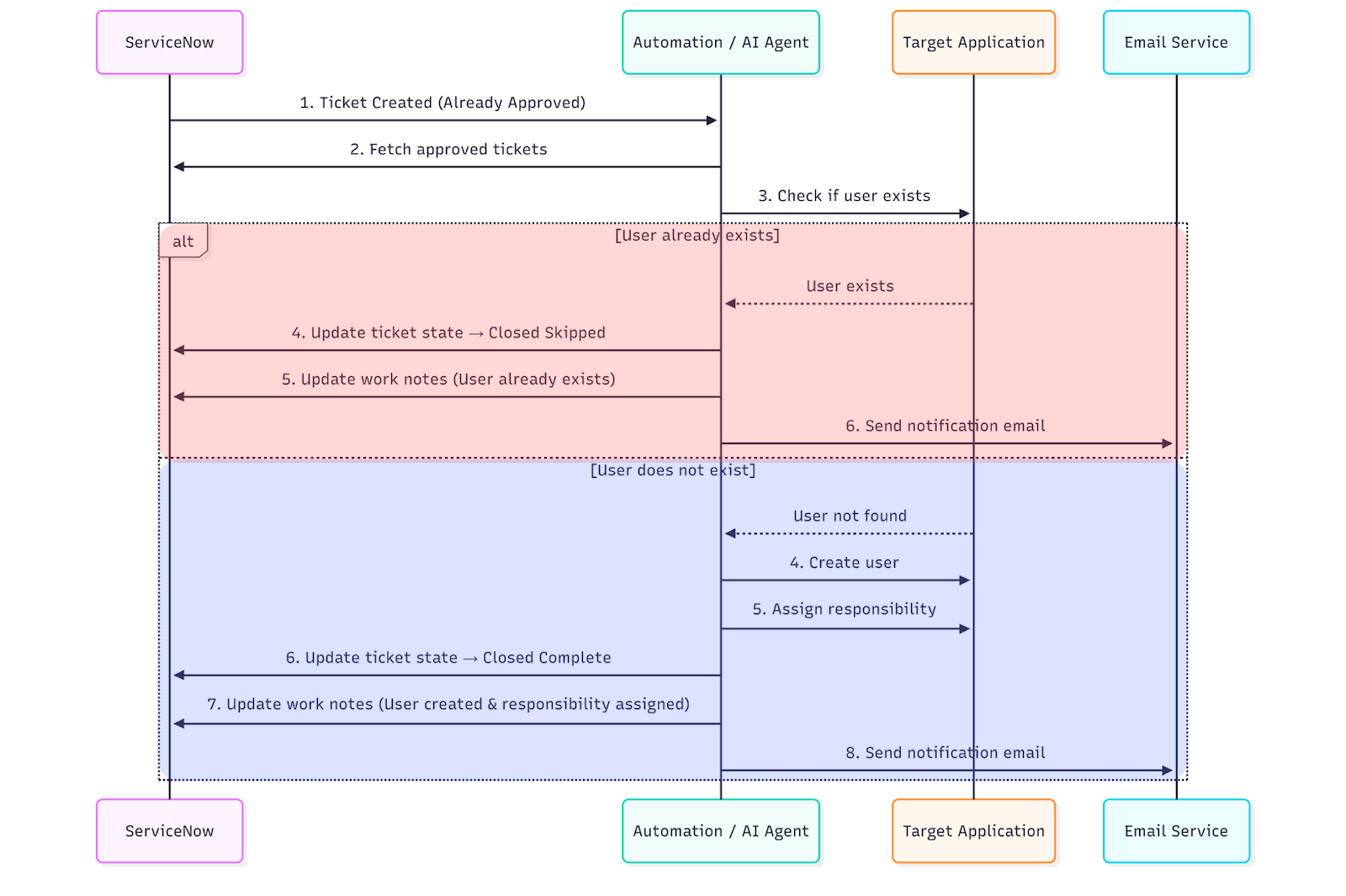
The diagram below illustrates the complete user provisioning lifecycle from ticket creation to automated closure
How the Automation Works
1) Ticket Monitoring
The agent continuously monitors ServiceNow for new user creation tickets.
2) Approval Handling
- If a ticket requires approval, the agent automatically sends a notification in the chat application to the designated approvers.
- The agent waits for approval before proceeding.
- If approval is already completed, it directly moves to the next step.
3) User Creation
Once approvals are received, the agent:
- Creates the user in the requested application.
Assigns responsibilities based on:
- A centralized role-to-responsibility mapping repository. It contains structured information, including job title, target application module, responsibility key, security group, and responsibility description.
- Sample Role-to-Responsibility Mapping Table:
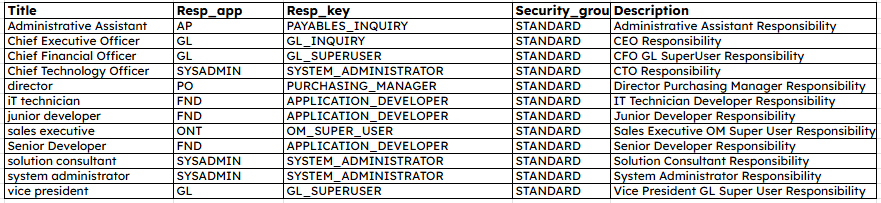
- Once a role is identified from the ticket, the AI agent searches this structured Excel file to find the matching job title and retrieves the associated application responsibilities (such as responsibility key and security group). These responsibilities are then assigned within the respective enterprise system during user provisioning.
- Mirror user selection (clones access from an existing user)
4) Notifications & Updates
After successful user creation:
- A confirmation message is sent to approvers via chat.
- The end user receives an email notification confirming account creation.
- ServiceNow is automatically updated:
- Approval status → Approved
- Ticket status → Closed Complete.
This ensures full transparency and traceability.
Key Challenges Faced
One of the major challenges was handling the differences in responsibility assignment logic across systems.
Each platform had its own way of managing roles and access. For example:
- Some systems required responsibility-based mapping.
- Others used profile or permission-based access.
- Certain platforms relied on role inheritance or group-based access.
Designing a unified agent that could understand and apply system-specific logic dynamically required careful planning and deep integration.
Impact & Results
The intelligent automation solution transformed the process in several ways:
- Reduced manual effort significantly
- Accelerated ticket closure time
- Improved onboarding experience
- Minimized human errors
- Enabled 24/7 processing capability
- Standardized access provisioning across systems
What previously required 30 minutes of manual effort per ticket by L1 engineers is now fully automated, with the only human touchpoint being the required business approvals.
This implementation demonstrates how the Ops Agent enables AI for ITSM in action by driving autonomous execution of operational workflows across enterprise environments.
Key Takeaways
This implementation demonstrated that intelligent automation can do much more than just assist it can actively manage operational workflows.
By combining automation, intelligent decision-making, and system integrations, organizations can:
- Eliminate repetitive manual work.
- Improve efficiency and response time.
- Ensure consistency in access management
- Free up teams to focus on higher-value tasks
Conclusion
User creation is a fundamental but repetitive process in enterprise operations. With increasing ticket volumes and multiple systems involved, manual handling becomes inefficient and unsustainable.
By introducing an AI-driven solution - Ops Agent, we successfully automated the entire user creation journey, from approvals to provisioning and notifications. This not only reduced operational workload but also created a faster, smarter, and more reliable access management process.
This approach showcases how IT operations automation powered by AI can transform enterprise IT,moving from manual execution to intelligent, autonomous operations.
Looking to automate your IT operations? Discover how Jade Global experts can help you move from manual processes to autonomous execution.
Subscribe to our Technology Insights





About the Author

How Can We Help You?
Related Posts