Boost IT Operations Productivity with AI-Powered Incident Triage - Powered by Jade Global’s Ops Agent
Prasad Tupe , Farzana Shaikh
Mar 24, 2026
Summary: A lot of incident response time is lost figuring out ticket priority, ownership, and the right resolution steps. Jade Global’s AI-powered Ops Agent helps teams handle this automatically—routing incidents correctly, surfacing relevant SOPs, and helping engineers resolve issues faster while keeping SLA performance on track.
Incident response teams lose valuable time deciphering tickets, hunting for SOPs, and relying on tribal knowledge. These delays increase MTTR (Mean Time To Resolution), strain engineers, and lead to inconsistent resolutions.
At Jade Global, we address this challenge through our AI-driven Ops Agent. As organizations increasingly adopt AI for ITSM and intelligent automation for IT operations, the need for structured automated incident management is becoming critical for improving service reliability and operational efficiency.
Within the PCAR (Prevent, Capture, Act, Retrospect) model, one of the agents that we have developed, functions as the AI-Powered Incident Triage & Resolution Suggester Engine. It proactively analyzes incoming incidents, validates their priority, assigns them to the appropriate teams, and provides technicians with context-aware resolution guidance—helping reduce resolution times, ensure consistent handling, and enable teams to focus on higher-impact work.
This approach acts as an AI solution for ITSM, combining intelligent automation with operational context to modernize incident management workflows.
A Day in the Life of an Incident Response Team
It’s 10:15 AM. A high-priority incident hits the ITSM system:
- A ticket comes in saying, “The application is slow for multiple users.”
The on-call engineer picks it up and starts figuring out what’s actually going on.
- Is this really a priority-one incident?
- Which team is responsible for the application?
- Is the slowdown coming from the network, the database, or something the team has seen before?
To find answers, they begin digging through the ticket details, looking at similar incidents from the past, checking the knowledge base, and reviewing the standard operating procedures.
While all this investigation is happening, the clock keeps moving. Users are already feeling the impact, and the pressure to meet the SLA starts building.
Across the team, similar incidents are being handled—often differently—depending on who picks up the ticket and how familiar they are with the issue.
Sound familiar?
These aren’t edge cases. They are everyday realities for incident response teams.
Many organizations facing these challenges start exploring automated incident management examples and modern AI-powered support automation platforms to reduce the manual burden on engineers.
The Hidden Cost of Manual Incident Handling
One incident on its own may not feel overwhelming. But when engineers deal with dozens of similar tickets every day, the time spent on manual triage and investigation starts to add up.
For engineers, this often means:
- Spending time trying to understand unclear or incomplete ticket descriptions.
- Manually checking the correct priority and identifying the responsible team.
- Jumping between multiple tools, dashboards, and documentation to gather context
- Dealing with the stress of SLA commitments while still figuring out the next step
New or less experienced engineers often hesitate, escalate too early, or take longer to resolve issues which impacts confidence and productivity.
These inefficiencies highlight the growing need for IT support automation and IT operations automation, where AI assists teams with triage, routing, and resolution guidance.
For Support Teams
- Incorrect priority assignments leading to noise and alert fatigue.
- Tickets routed to the wrong teams.
- Repeated effort resolving the same types of incidents.
- Inconsistent responses to similar problems.
- Senior engineers pulled into routine incidents rather than complex work.
For the Business
- Increased Mean Time to Resolution (MTTR).
- SLA breaches due to poor triaging and reduced service reliability.
- Higher operational costs and slower incident recovery.
In many organizations, a significant portion of incident resolution time is spent determining who should handle the issue and how urgent it really is, rather than fixing it.
This is where AI incident triage for enterprises and AI-driven automation for IT support solutions can dramatically improve operational efficiency.
The Jade Global Ops Agent – AI Incident Triage & Resolution Suggester Engine
To address these challenges, we designed and implemented an Autonomous automation solution aligned with the ACT pillar of Jade Global’s PCAR framework.
This Ops Agent acts as an intelligent operational decision layer—handling incident intake, triage, routing, and resolution guidance in one continuous flow.
Instead of manual search, engineers receive structured, validated, and actionable intelligence directly within the ticket.
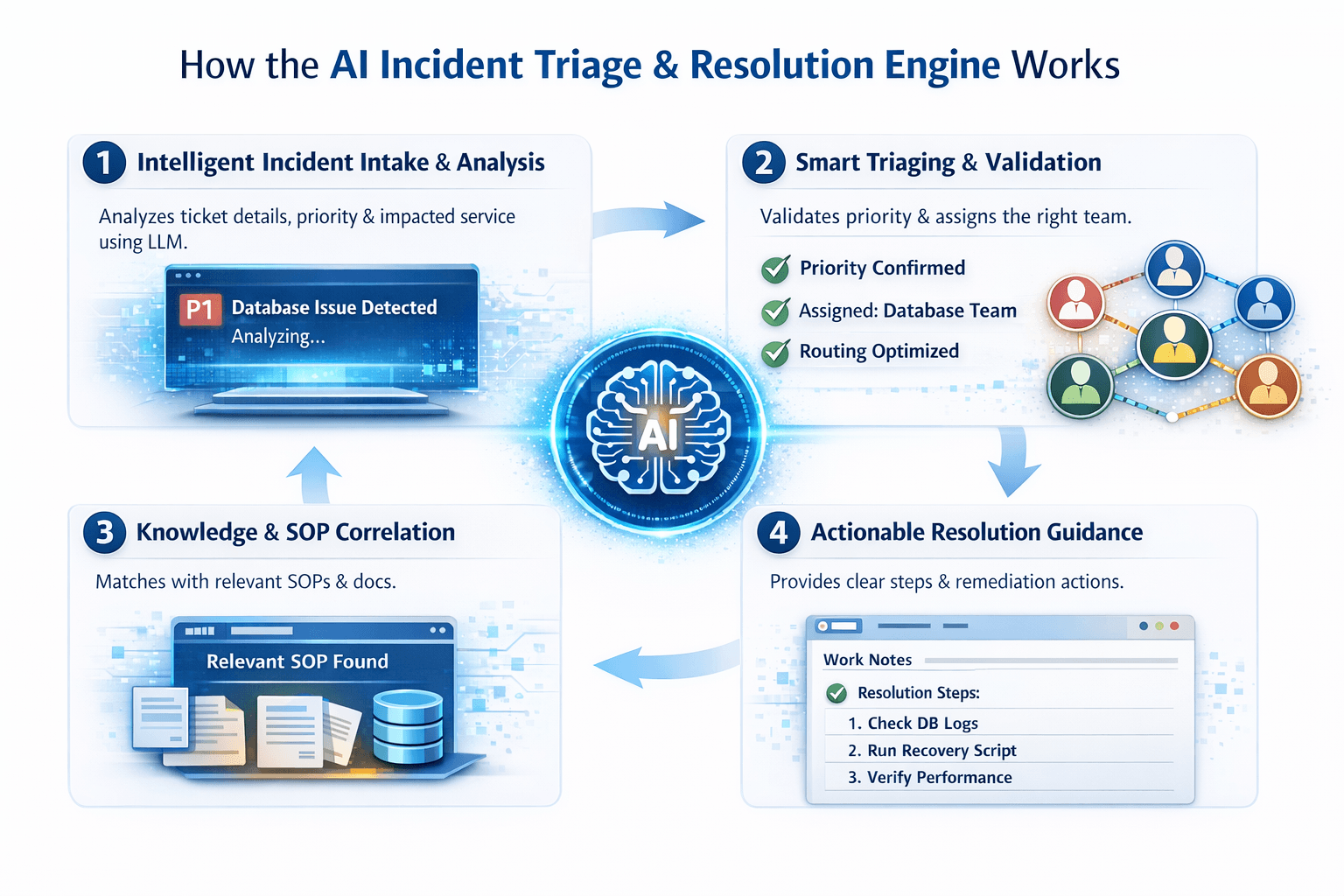
How the AI Incident Triage & Resolution Suggester Engine Works
Step 1: Intelligent Incident Intake & Analysis
When a new incident is created, the AI analyzes:
- Ticket description and metadata, if required.
- User-selected priority and category.
- Impacted service or application
Using a Large Language Model (LLM), the system understands the intent, context, and severity of the incident—not just keywords.
Step 2: Smart Triaging & Validation
Before resolution begins, the AI performs intelligent triage:
- Priority Validation: Checks whether the selected priority aligns with the described impact and historical patterns.
- Team Ownership Identification: Determines which team (application, infrastructure, network, database, etc.) should own the incident.
- Routing Recommendations: Suggests the correct assignment group, reducing misrouted tickets and unnecessary reassignments.
This ensures incidents start their lifecycle with the right priority and the right owners immediately after they are created and is a part of automated incident management.
Step 3: Knowledge & SOP Correlation
Once triaged, the AI correlates the incident with:
- Relevant SOPs and docs
- Internal knowledge repository
Such capabilities are increasingly seen in AI-powered support automation platforms, where AI surfaces relevant operational knowledge during incident resolution.
Step 4: Actionable Resolution Guidance Inside the Ticket
The resolution suggester generates:
- Clear steps
- Recommended remediation actions
- Relevant links, commands, or checklists
These recommendations are added directly to the ticket as work notes, allowing engineers to act immediately—no tab switching, no searching.
Real-World Scenario: AI-Powered Incident Response in Action
A recurring database performance issue is raised during peak business hours and marked as P1.
Without AI
- The priority is debated.
- Tickets can get routed to the wrong team in the absence of clear guidelines.
- Engineers manually search past incidents and SOPs.
- Resolution is delayed
- Escalations increase
Result: Higher MTTR, inconsistent handling, and unnecessary operational noise.
With Jade Global’s Ops Agent - AI Incident Triage & Resolution Suggester Engine
- The incident priority is automatically validated and confirmed.
- Ownership is correctly assigned to the database team.
- The issue is instantly recognized as a known pattern.
- Relevant SOPs and remediation steps are surfaced in real time.
Impact:
✔ 30–40% Faster Resolution (Reduced MTTR)
Engineers receive instant, contextual guidance, — eliminating manual lookup time.
✔ Up to 50% Faster Onboarding
New engineers confidently follow AI-aligned SOP recommendations.
✔ Consistent Incident Handling
Similar incidents are triaged, routed, and resolved using standardized intelligence — regardless of who handles the ticket.
✔ Improved Operational Efficiency
Teams spend less time searching and more time resolving high-value issues.
✔ Reduced Noise & Escalations
Accurate triaging minimizes unnecessary escalations and reassignment loops.
These outcomes demonstrate how AI-powered ITSM for operational efficiency and intelligent automation for IT operations can transform the way enterprises manage incidents.
Who Benefits Most?
- L1 and L2 support engineers.
- NOC, SRE, and Operations teams.
- Incident and Application managers.
- Enterprises with high incident volumes.
- Organizations focused on SLA excellence.
Conclusion: From Reactive to Intelligent Incident Management
Traditional incident management relies heavily on manual workflows — such as human-driven classification, prioritization, routing, and resolution steps — which can be time-consuming, inconsistent, and prone to error. Research and industry experience show that AI-powered incident management can automate many of these steps, leading to measurable improvements in efficiency, speed, and quality of service delivery.
By validating priorities, routing incidents correctly, and delivering contextual guidance at the right time, an AI Incident Triage & Resolution Engine helps teams:
- Reduce manual effort and operational friction.
- Shorten resolution times (with reported MTTR reductions of ~30–40% or more).
- Improve consistency in incident handling.
- Enable engineers to focus on higher-value, strategic tasks instead of repetitive work.
Modernize your incident response with AI. Discover how Jade Global’s Ops Agent for AI-driven IT operations helps enterprises automate triage, reduce MTTR, and improve service reliability.
Subscribe to our Technology Insights





About the Author

About the Author

How Can We Help You?
Related Posts