

Architecting the Intentional AI Ecosystem: From AI Sprawl to Enterprise Strategy
A framework for technology leaders to govern AI as an enterprise capability - not just a collection of copilots.
Shankar Subramanyam
Jul 24, 2026
Most enterprises didn't choose their AI architecture. They inherited it — one SaaS renewal at a time.
Over the past two years, AI has quietly become part of almost every enterprise application. CRM platforms now have AI assistants. Developer tools generate code. HR systems summarize employee information. ITSM platforms automate incident resolution. Productivity suites draft documents and meeting notes. Analytics platforms answer questions in natural language.
Individually, these innovations improve productivity. Collectively, they introduce a new architectural challenge that many organizations are only beginning to recognize: how do you govern an enterprise where intelligence exists everywhere?
This isn't simply another wave of software adoption. It's the emergence of an enterprise AI ecosystem. The question is whether that ecosystem is evolving intentionally — or by accident.
AI Has Become An Architecture Problem
Enterprise Architecture has successfully navigated cloud adoption, SaaS proliferation, microservices, APIs, and platform engineering. AI is the next wave — but it differs from every previous one in a crucial way: it doesn't simply execute business processes. It interprets enterprise knowledge. Every AI assistant becomes another pathway into customer information, contracts, financial reports, source code, operational data, and institutional knowledge.
As AI adoption accelerates, Enterprise Architecture must evolve from governing applications to governing intelligence.
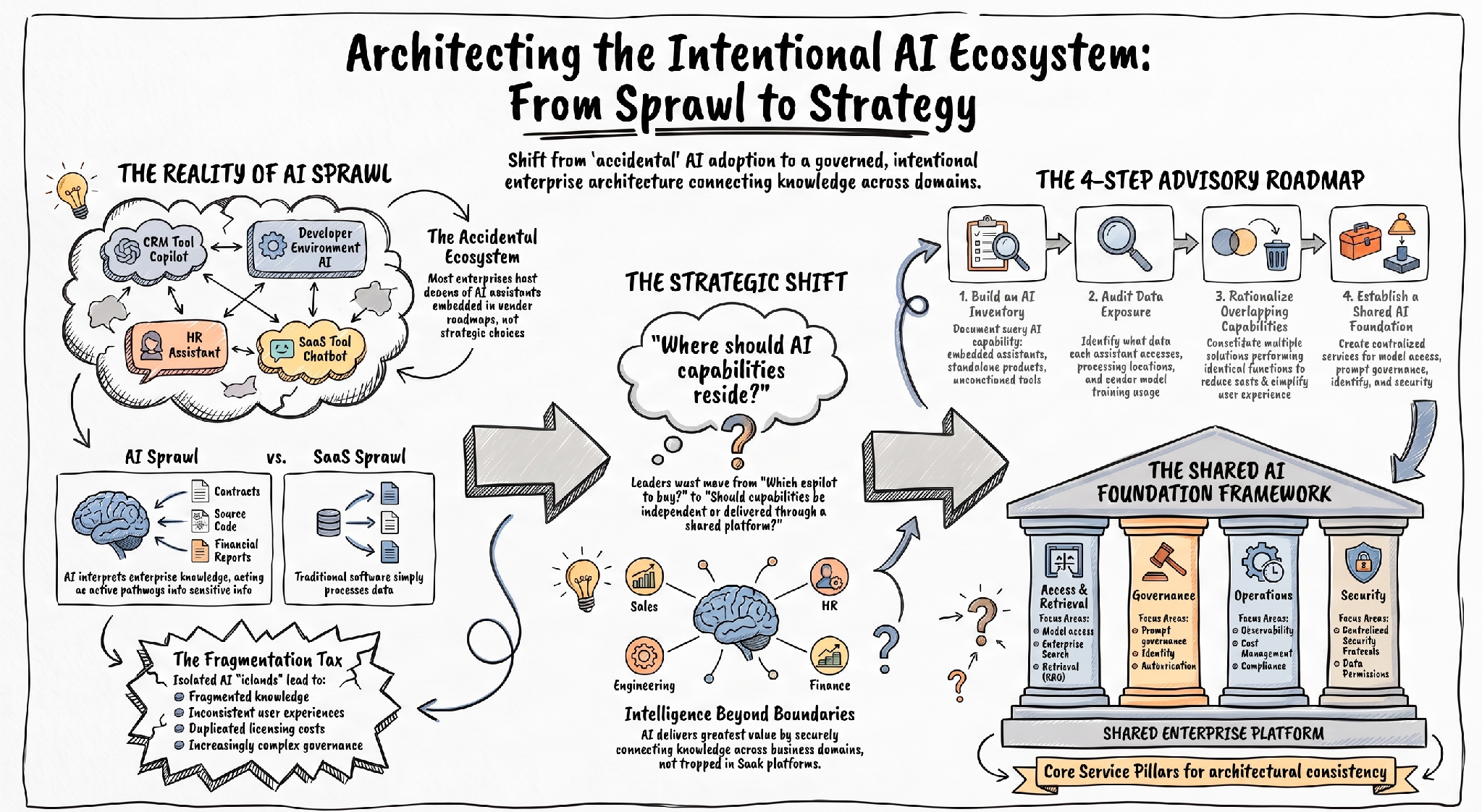
The Hidden Cost of AI Sprawl
Most organizations don't intentionally deploy dozens of AI assistants. They inherit them through SaaS platforms, business-unit purchases, and developer tooling — and a shadow layer grows beneath all of it. The Microsoft/LinkedIn Work Trend Index found that 78% of employees who use AI at work bring their own tools rather than waiting for sanctioned ones, and MIT's Project NANDA research found workers at over 90% of surveyed firms regularly using personal AI tools while only around 40% of those firms had purchased enterprise subscriptions. The true assistant count in any large enterprise is the embedded ones, plus the purchased ones, plus a shadow layer larger than both.
This creates what I call the Fragmentation Tax: knowledge becomes trapped inside individual platforms; employees experience inconsistent AI capabilities; organizations pay repeatedly for overlapping functionality; security and governance become increasingly difficult; and enterprise intelligence becomes fragmented instead of connected.
Ironically, the more AI products an organization acquires, the harder it becomes to realize enterprise-scale AI value.
The Strategic Shift
Technology leaders should move beyond asking: Which AI assistant should we buy?
Instead, ask: Where should AI capabilities reside within our enterprise architecture?
Rather than allowing every application to become its own AI platform, organizations should establish shared enterprise AI capabilities that every application can consume.
The Shared AI Foundation: Four Pillars
A shared AI foundation complements vendor copilots rather than replacing them. It rests on four pillars of common enterprise services:
- Access & Retrieval — enterprise model access and shared retrieval and knowledge services, so every application draws on the same governed intelligence rather than its own silo.
- Governance — prompt governance and identity-aware authorization, so what an AI can see is determined by who is asking, not by which vendor built it.
- Operations — observability, cost management, and compliance, so someone can actually answer what AI systems did in the enterprise yesterday and what it cost.
- Security — centralized guardrails and data permissions, applied once and inherited everywhere, instead of negotiated fifty times in fifty vendor contracts.
Business applications continue to innovate while consuming these shared architectural capabilities.
A Four-Step Advisory Roadmap
- Build an Enterprise AI Inventory. Document every AI capability operating across the organization — embedded assistants, standalone products, and unsanctioned tools. The diagnostic question: can your organization produce this list today? Most cannot, and the inventory alone typically pays for itself.
- Audit Enterprise Data Exposure. Determine what enterprise data each AI capability can access, where it is processed, and how it is governed. The killer question: which of your assistants retain prompts or use your data for model training? If no one can answer, that is the first finding.
- Rationalize Overlapping Capabilities. For each redundant assistant, make an explicit call: consolidate, tolerate, or retire. In practice, the retire list is often 20–30% of the inventory — broad data access, weak terms, low usage. That is pure risk with no offsetting value.
- Establish a Shared AI Foundation. Create the reusable enterprise AI services above, sequenced by consumption: gateway the highest-volume workloads first, and make the sanctioned path faster than buying another point solution. Consolidation follows adoption; it cannot precede it.
Final Thoughts
Organizations won't gain a competitive advantage simply by deploying more AI assistants. They'll gain one by intentionally architecting how intelligence operates across the enterprise. Enterprise AI is becoming a foundational architectural discipline alongside cloud, identity, networking, integration, and platform engineering.
Technology leaders shouldn't treat architecture as the function that slows AI adoption — it's the function that makes AI adoption survivable at scale. The governance, interoperability, and shared services described here are what allow intelligence to scale securely, so the ecosystem evolves by design rather than by default. And the sprawl only compounds from here: every assistant an enterprise can't inventory today becomes an agent it can't govern tomorrow.
For organizations beginning this journey, the enterprise AI inventory is usually the most valuable first step. It requires no new technology, creates immediate visibility, and informs every decision that follows — from governance and security to vendor consolidation and platform investment.
At Jade Global, we believe the path to enterprise AI success starts with an intentional AI ecosystem—one that combines governance, data, architecture, and AI operations into a unified strategy rather than isolated initiatives.
Subscribe to our Technology Insights





About the Author

How Can We Help You?
Related Posts