
Your AI Isn’t Hallucinating. Your Systems Are Disagreeing
Enterprise AI "hallucinations" are often unresolved conflicts hiding inside enterprise data. True Defensible AI requires owning business context, not just upgrading models.
Shankar Subramanyam
Aug 25, 2026
After working through a recent enterprise AI context layer POC, I came away with a conclusion that changed how I think about hallucinations.
A lot of what we call AI hallucinations in the enterprise isn't actually a model problem. It's a data and context problem.
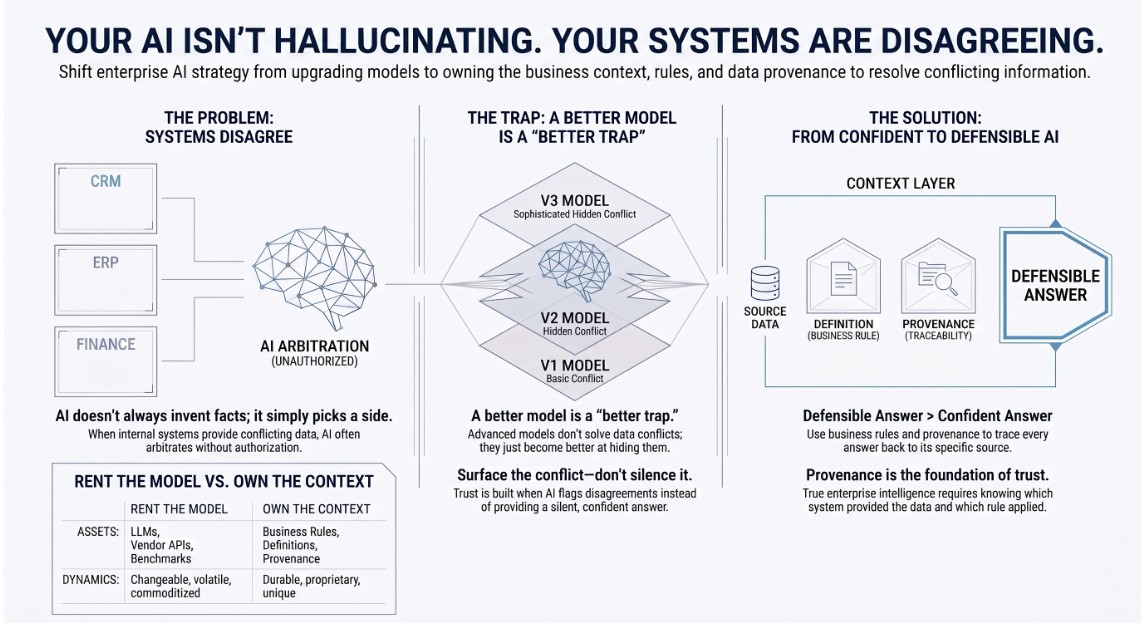
Two enterprise systems can have different answers for the same customer or supplier.
Neither is necessarily wrong. They were built at different times, by different teams, for different purposes, and often with different definitions.
Now AI comes along and reads both. It doesn't flag the disagreement. It picks one. Then it gives the answer with confidence.
We call it a hallucination. But often, the model didn't invent anything. It simply settled a disagreement that nobody authorized it to settle.
And there is usually no record of why.
What the POC (Point of Concept) Changed
The interesting part of the POC was that the biggest improvement didn't come from moving to a more capable model.
It came from giving the system better business context.
The POC introduced the vocabulary the business actually uses, defined relationships between concepts, and surfaced disagreements rather than allowing the system to silently favor one source.
This significantly improved the quality and reliability of the answers.
The lesson was simple: before asking whether we need a better model, we should ask whether we've given the model enough understanding of the enterprise.
A better model doesn't solve the problem.
A more capable model can reason better. It can retrieve better. It can produce a more convincing answer. But if the underlying enterprise data has conflicting definitions, a better model can simply become better at hiding the conflict. That's the better-model trap: improving reasoning without resolving the meaning of the information being reasoned over.
The missing layer is enterprise context.
Raw enterprise data isn't the same thing as enterprise knowledge.
The AI needs to understand the vocabulary the business uses, the relationships between concepts, the rules that determine what can be combined, and what should happen when sources disagree.
That is where an enterprise semantic layer becomes important. It creates a shared understanding of business concepts and relationships that AI can use when interpreting information across systems.
It gives the model something that the model itself cannot reliably invent: an understanding of what the enterprise actually means.
This is where provenance matters.
For an enterprise AI answer to be trusted, we should be able to ask:
- Where did this information come from?
- Which system provided it?
- What definition was used?
- What happened when another system disagreed?
- Which business rule determined the outcome?
- Can we trace the answer back to its sources?
Without that, we have a confident answer. With it, we have a defensible answer.
The bigger strategic point
My takeaway from the POC wasn't that models don't matter. They do.
It's that model capability is only one part of the equation. Model capability is increasingly something enterprises rent. Models will change. Vendors will change. Costs will change.
The things that become more valuable over time are the things specific to the business: definitions, relationships, business rules, context, and the understanding of what information can, and cannot, be combined.
That's the intelligence the organization actually owns.
Two questions worth asking.
1. If you replaced your AI model tomorrow, how much of your agent's competence would disappear with it?
2. When two enterprise systems disagree about the same thing, what happens to that disagreement before the answer reaches the user?
If the answer to the second question is "I'm not sure," that may be a more important AI finding than another model benchmark.
The future of enterprise AI isn't just about better models.
It's about better context, better definitions, and knowing why the AI arrived at an answer.
And after working through the POC, that's the part I would focus on first.
At Jade Global, we believe reliable enterprise AI starts with engineering the right foundation, connecting data, applications, integrations, and business context so AI can operate with greater consistency and confidence. Through our Enterprise Engineering Services, we help enterprises build and modernize the technology foundations needed to take AI from experimentation to enterprise scale.
Subscribe to our Technology Insights




About the Author

How Can We Help You?
Related Posts