Top Enterprise AI Platforms For CIOs in 2026
Vinit Verma
Jan 12, 2026
Key Takeaways:
- AI delivers value when platforms are connected and working in concert, not when another standalone tool is added to the stack.
- In practice, progress comes from using AI where people already work, and extending it with agents that can move across systems when needed.
- What separates results from pilots is execution: clean data, clear ownership, and governance that keeps AI usable at scale.
The Enterprise AI Reality in 2026
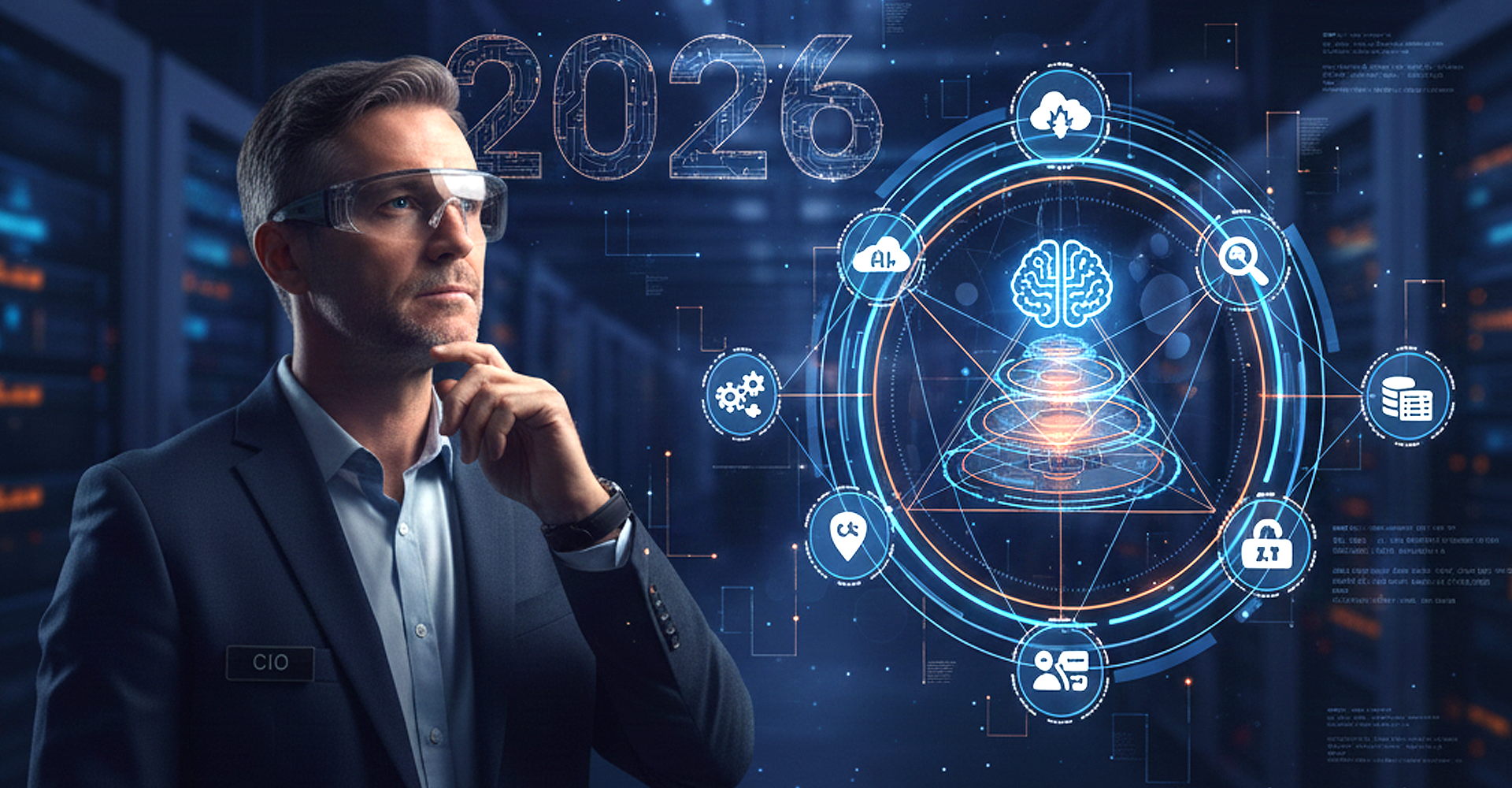
By 2026, AI will no longer be a future initiative or an innovation experiment. It is becoming part of how enterprises operate, decide, and compete. This shift sits within a broader set of AI priorities explored in Top AI Trends Every CIO Must Watch in 2026, which brings together the wider context shaping CIO decisions this year.
For CIOs, the question is no longer whether to adopt AI, but how to do it without increasing fragmentation, risk, or technical debt. The enterprise AI platform market has matured quickly, narrowing to a set of platforms that consistently deliver value at scale.
The organizations seeing results are taking a pragmatic approach. They activate AI capabilities inside platforms they already trust, while selectively investing in specialized enterprise AI platforms to support agent-driven, cross-system automation. In practice, success comes from combining both.
The Strategic Choice CIOs Are Making
Most enterprises run on a patchwork of systems that have grown over time. In that environment, AI that lives in a silo tends to struggle once it meets real workflows, real data, and real constraints.
That’s why many CIOs are stepping back from one-off AI tools and moving toward platforms. What matters now isn’t the novelty of a model, but whether AI fits naturally into the systems people use every day, whether it can carry work from one application to another, and whether the data and integrations behind it hold up as usage grows.
What ultimately makes the difference is clarity. When leaders understand where each platform fits and what problem it is meant to solve, AI initiatives move forward. When they don’t, even well-funded pilots tend to stall.
Business Application Platforms: AI Embedded in Daily Work
Embedded AI platforms deliver immediate value by reducing friction and accelerating decisions inside core business systems.
- Salesforce Agentforce: For enterprises with deep Salesforce adoption, it enables sales, service, and marketing automation without creating a separate AI stack. This makes it one of the most practical enterprise AI agent platforms for customer-facing operations.
- ServiceNow Now Assist: ServiceNow has integrated AI across IT, HR, and customer service processes. Capabilities such as summarization and recommended resolutions help teams close complex cases faster, reinforcing ServiceNow’s position as a conversational AI platform for enterprise service workflows.
- Oracle AI: Oracle has embedded AI across finance, supply chain, HR, and CX workflows. The organizations already running Oracle Cloud approach enables intelligence activation with minimal integration overhead, making it a strong fit for regulated enterprise environments.
- Workday AI: Workday’s AI shows up in everyday people and finance work, helping teams plan better, catch issues early, and spend less time on paperwork. Its real value comes from the broader patterns it learns across large enterprises, not just from one organization’s data.
- SAP Joule: SAP Joule functions as a conversational assistant across systems such as S/4HANA, SuccessFactors, and Ariba. It is particularly effective in manufacturing and supply chain environments where guided insights reduce operational complexity.
- Microsoft Dynamics 365 Copilot: Microsoft extends AI across sales, finance, and customer engagement while tightly integrating it with Microsoft 365 and Teams. This allows AI-driven insights to flow naturally between productivity tools and enterprise applications.
AI and Integration Platforms: Enabling Enterprise-Scale Agents
As AI agents move beyond single applications, integration and data platforms become essential. This is where enterprise AI strategies either scale or stall.
- Boomi: Boomi provides the connectivity AI agents depend on. With extensive connectors, AI-assisted integration development, and agent orchestration capabilities, it enables agents to retrieve data and execute actions across systems, making it a foundational enterprise AI agent platform layer.
- Workato: Workato sits in that middle ground where IT still has control, but business teams can move faster. Its AI reduces some of the friction in building workflows without turning automation into a free-for-all.
- Snowflake Cortex: Snowflake Cortex works where the data already is. There’s no need to move it around just to make AI work, which makes life simpler for teams that have to worry about security and compliance every day.
- Databricks: Databricks unifies data engineering, analytics, and AI development through its Lakehouse architecture. Mosaic AI supports large-scale AI application development across enterprise data estates.
Platforms Worth Watching
Several platforms are shaping how enterprise AI will evolve:
- AWS Bedrock
- Azure AI
- Google Vertex AI
- UiPath
- Glean
- CrewAI
These platforms tend to complement, not replace, core enterprise systems.
What This Means for CIOs
By 2026, the real advantage won’t be who has access to the latest AI model. It will be whoever knows how to put AI to work in everyday operations. The CIOs making progress are treating enterprise AI as part of the core infrastructure, not a side experiment, and keeping their attention on coordination, guardrails, and outcomes that actually show up in the business.
How Jade Global Helps Enterprises Execute AI at Scale
Selecting platforms is only part of the journey. The real challenge lies in making them work together.
Jade Global helps enterprises design, integrate, and operationalize AI across Salesforce, ServiceNow, Oracle, SAP, Workday, Boomi, Snowflake, and Databricks. The focus is on:
- Defining the right mix of embedded AI and enterprise AI agent platforms.
- Building governed, enterprise-ready AI agents with human oversight.
- Integrating AI across systems without disrupting core operations.
- Establishing scalable governance and data foundations for long-term value.
Ready to assess which enterprise AI platforms will drive real value for your organization? Connect with Jade Global to define a practical, outcome-driven AI platform strategy.
Subscribe to our Technology Insights




About the Author

How Can We Help You?
Related Posts