

Top AI Trends Every CIO Must Watch in 2026
Vinit Verma
Jan 12, 2026
Key Takeaways:
- AI is shifting from experimentation to execution.
- 2026 will be a decisive year for enterprise AI.
- Focused bets will matter more than broad pilots.
For years, AI sat on the sidelines of enterprise strategy—interesting, promising, but not decisive. In 2026, that will change. With AI spending expected to pass $2 trillion, enterprise leaders now see AI as core infrastructure. The real question is no longer if AI matters, but how quickly the enterprise can turn it into meaningful value.
The signals are hard to miss. Nearly 69 percent of executives expect agentic AI to reshape how the enterprise operates. AI budgets, once tucked inside innovation programs, are now part of annual planning and growing at 75 percent year-over-year. But the acceleration also exposes a familiar constraint: data maturity. Gartner warns that over 60 percent of AI projects may fall short without strong data foundations.
The takeaway is clear: enterprises that anchor AI in well-defined use cases, strong data, and integrated platforms will move faster. Those still circling in pilot mode risk losing ground as AI becomes central to everyday enterprise operations.
Why the CIO Has Become the Center of Enterprise AI
AI no longer sits neatly within “technology strategy”; it now influences hiring in HR, planning in Finance, and customer experience across the enterprise. That’s why 81 percent of CIOs are now working more closely with other leaders.
As AI scales, the CIO’s remit expands with it. Today’s CIO is expected to:
- Align enterprise leaders on where AI truly creates value.
- Prepare the workforce as AI agents take on more responsibilities.
- Bring AI governance into board-level discussions.
- Build the enterprise’s “data and AI factory,” from pipelines to model lifecycle and value tracking.
This broader scope forces a new kind of discipline. With endless AI possibilities, CIOs are increasingly asked not just what they can pursue, but what they should stop pursuing. The enterprises moving fastest aren’t running more experiments; they are making better choices.
Budgeting and Investment Priorities for CIOs in 2026
AI budgeting in 2026 is less about experimentation and more about disciplined execution. CIOs are being pushed to prove value in an environment shaped by economic uncertainty, geopolitical risk, and increased board-level scrutiny. The focus is shifting toward strong data foundations, modern integration, clear governance, and AI use cases that deliver consistent returns. Just as important is preparing teams to work effectively with AI, because sustainable value depends as much on people and process as it does on technology.
For a deeper look at how leading organizations are planning and prioritizing AI investments this year, explore our detailed perspective on: 2026 AI Spend Outlook: Navigating from Experimentation to Enterprise Value
What’s Actually Shaping the 2026 AI Landscape
Three latest AI trends are defining how AI progresses this year: the rise of agentic AI, deeper platform integration, and rapid governance evolution. Each of these is reshaping enterprise expectations.
From GenAI to Agentic AI
After a year of generative AI exploration, enterprises are now moving toward systems that act instead of simply generating content. Agentic AI represents that step forward, with systems capable of:
- Perceiving data from multiple systems.
- Planning and running multi-step workflows.
- Executing tasks with limited oversight.
- Learning and adapting based on outcomes.
This transition moves AI from a support tool to an operational partner that can handle repeatable work at scale.
The Data Readiness Gap
This shift has brought data back into focus. 65% of organization of organizations acknowledge they lack AI-ready data or are unsure of their maturity. Meanwhile, those with strong data foundations see 26 percent better business outcomes—a gap that will only widen. What AI-ready data requires is straightforward but often underinvested:
- Use-case alignment.
- Quality, accuracy, completeness.
- Governance tailored to context.
The Regulatory Climate Becomes Real
For the first time, regulatory expectations are taking concrete form. CIOs must now prepare for major 2026 milestones, including:
- EU AI Act – obligations beginning August 2026.
- EU Cyber Resilience Act – reporting requirements from September 2026.
- ISO/IEC 42001:2023 – standardizing AI governance globally.
- Regional frameworks such as:
- Japan’s AI Promotion Act
- Singapore’s National AI Strategy 2.0
- UK Cyber Security and Resilience Bill
These frameworks are adding structure and accountability to AI deployment.
Top AI Trends 2026 That Will Reap Highest ROI for CIOs
Not all AI investments deliver equal returns. Based on enterprise adoption data, market research, and real-world deployment outcomes, these trends represent the highest-ROI opportunities for CIOs in 2026.
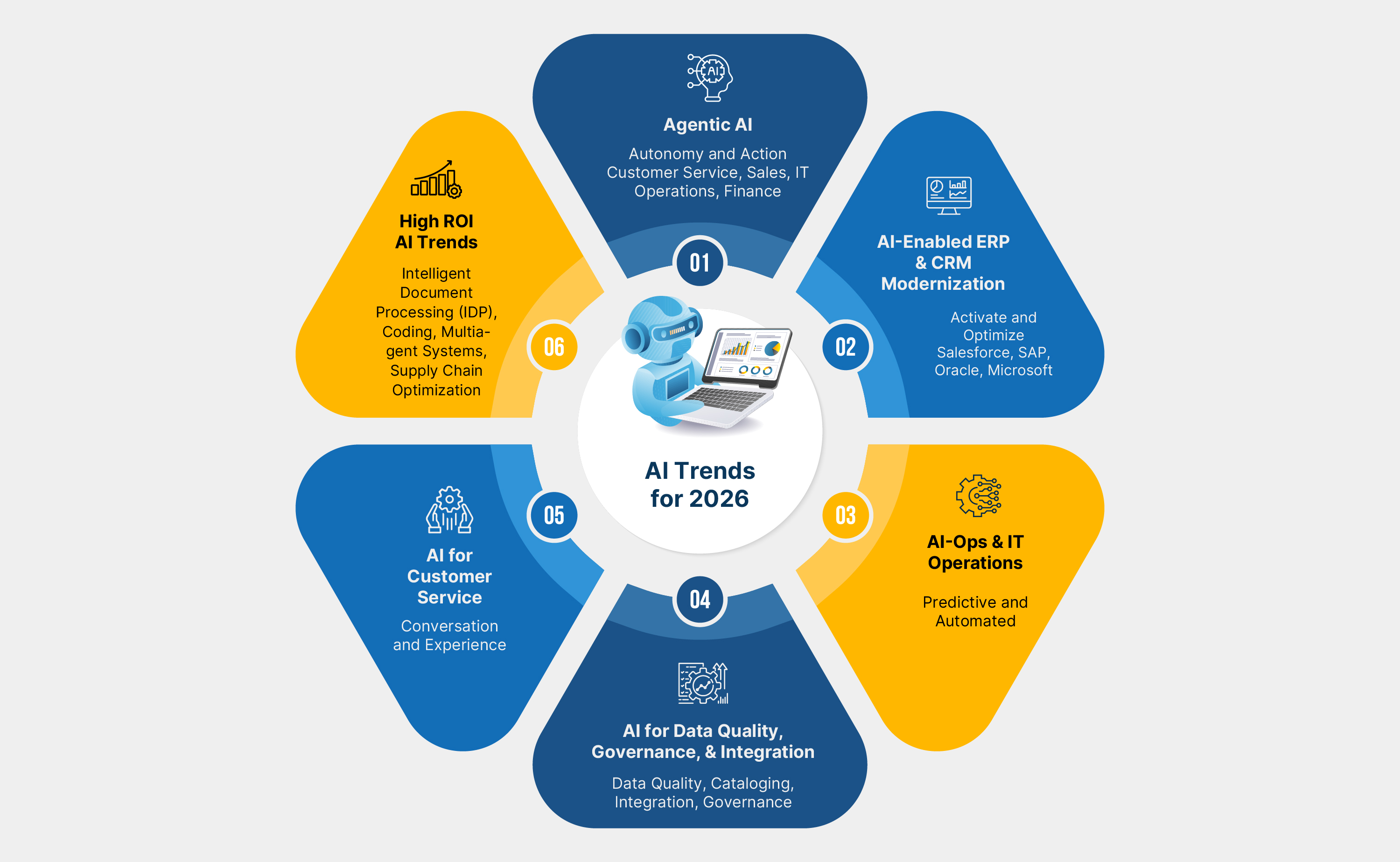
Agentic AI
Agentic AI is quickly becoming the AI trend that will define the run-up to 2026. Nearly 79 percent of organizations are already using AI agents in some way, and that presence is only set to grow, with 33 percent of enterprise software expected to include agentic capabilities by 2028.
What’s driving this shift is simple. Unlike traditional AI that waits for instructions, agentic AI can gather context, make decisions, and take action on its own. As enterprises see the impact of that autonomy, investment is accelerating—the agentic AI market is projected to grow from $5.2 billion in 2024 to $196.6 billion by 2034, at a 43.8% CAGR.
Enterprise Applications:
- Customer Service Agents: Handling inquiries, resolving issues, and managing escalations autonomously.
- Sales Development Agents: Researching leads, personalizing outreach, and booking meetings.
- IT Operations Agents: Monitoring systems, diagnosing issues, and executing remediation.
- Finance Agents: Processing invoices, managing approvals, and handling reconciliation.
AI-Enhanced ERP & CRM Modernization
Every major enterprise platform vendor has embedded AI capabilities into their core offerings. The question is no longer whether to adopt AI in your ERP and CRM—it's how quickly you can activate and optimize these capabilities.
Key Developments:
- Salesforce Agentforce: Autonomous agents for sales, service, and marketing that work within the Salesforce ecosystem.
- SAP Joule: Natural language AI assistant embedded across SAP applications for ERP, supply chain, and HR.
- Oracle AI: Embedded AI across Oracle Cloud applications for finance, supply chain, and customer experience.
- Microsoft Dynamics 365 Copilot: AI assistance across the full Dynamics suite.
AIOps & Autonomous IT Operations
By 2026, Gartner predicts 30 percent of enterprises will automate more than half of their network activities. AIOps represents the application of AI to IT operations—predictive monitoring, automated incident response, and intelligent resource optimization.
Business Value:
- Predictive Issue Detection: Identify and resolve problems before they impact users.
- Automated Remediation: Reduce mean time to resolution by 40-60%.
- Capacity Optimization: Right-size infrastructure spending based on actual usage patterns.
- Security Enhancement: 56% of companies have derived value from using GenAI for cybersecurity to identify threats and reduce incident resolution time
AI for Data Quality, Governance, and Integration
Data is the foundation of every AI initiative. Organizations are increasingly deploying AI to improve the quality, governance, and integration of their data assets—creating a virtuous cycle where better data enables better AI.
Critical Capabilities:
- Automated Data Quality: AI-powered profiling, cleansing, and enrichment.
- Intelligent Data Cataloging: Automatic metadata extraction and classification.
- Smart Integration: AI-assisted mapping and transformation for data pipelines.
- Dynamic Governance: Context-aware access controls and compliance monitoring.
Half of the leaders in data-related roles are using GenAI to extract specific insights from massive, complex datasets. The organizations that invest in data quality and integration today will be the AI leaders of tomorrow.
AI for Customer Service
The #1 enterprise AI use case. CIOs consistently rank customer service as the area with the highest adoption, greatest enthusiasm, and best preparation for agentic AI. This is where ROI is most immediately visible.
The Numbers:
- Customer service conversations led by AI agents grew 22x in the first half of 2025.
- 68% of customer service interactions expected to be managed by agentic AI by 2028.
- Early AI adopters are 128% more likely to report high ROI in customer experience.
Additional High-ROI AI Trends
Intelligent Document Processing (IDP)
AI-powered extraction and processing of unstructured documents—invoices, contracts, claims, HR documents. Organizations report 60-80% cost reduction and processing time reduced from days to seconds.
AI-Powered Code Development
AI-native development platforms are empowering smaller, more agile teams to build software faster. Agentic AI enables 4x faster code debugging in DevOps workflows.
Multiagent Systems
Gartner identifies multi-agent systems, where multiple AI agents collaborate on complex tasks, as a top 2026 technology trend. These modular systems improve automation scalability by allowing specialized agents to work together.
AI for Supply Chain Optimization
Predictive AI in supply chain management shows 50% improvement in forecasting accuracy, reducing stockouts and overstock situations. Early adopters are positioned to control 73% of the $164 billion retail AI market by 2030.
The Growing Role of Enterprise AI Platforms in 2026
As AI becomes part of everyday work, enterprises are realizing they need strong platforms to support it. Instead of chasing every new tool, leaders are focusing on getting more value from the platforms they already use, adding specialized AI only where it truly makes a difference. The organizations pulling ahead are building AI on stable foundations, not quick fixes.
Read about Enterprise AI Platforms that Matter In 2026 to understand how CIOs are evaluating enterprise AI platforms for scale, governance, and long-term value.
AI in Action: Everyday Scenarios Creating Business Impact
The strongest proof of AI’s value comes from how teams use it in everyday work. Across industries, AI agents are stepping in to remove friction, speed up processes, and improve customer experiences.
In one fast-growing software organization, an AI test agent now creates test cases directly from requirements, saving thousands of hours each quarter and improving release quality. In another case, a support team uses an AI agent trained on manuals and past tickets to answer technical questions instantly, cutting response times and reducing escalations.
Similar stories are playing out across sales, service, and IT—where AI agents handle repetitive work so teams can focus on higher-value tasks.
The Time for Action Is Now
We have reached a moment where AI is no longer an experiment—it’s becoming part of how companies operate and compete. Enterprises that take clear, confident steps will build an advantage that compounds over time. Those who keep circling in “pilot mode” will find it harder to catch up.
Here are a few priorities that can help CIOs move forward with clarity in 2026:
- Get your data house in order. Without clean, well-governed data, even the best AI won’t deliver.
- Start where value is proven. Customer service remains the fastest way to see real ROI and build internal confidence.
- Use the platforms you already trust. Most CIOs are unlocking new AI capabilities inside the systems they already run.
- Strengthen integration early. AI agents are only as effective as the systems they can tap into.
- Bring governance into the conversation now. With regulations tightening, it can’t be an afterthought.
Jade Global partners with enterprises to move AI from strategy to real-world impact. With deep platform expertise, strong integration and data foundations, Jade helps teams turn momentum into measurable outcomes—faster and with confidence.
Ready to move from strategy to impact? Let's explore together!
Subscribe to our Technology Insights





About the Author

How Can We Help You?
Related Posts