
The Shift to Autonomous Network Operations: Moving Beyond Reactive Monitoring with AIOps
Prerit Bhalani
Jul 16, 2026
Summary: Traditional monitoring can tell you when something goes wrong. Autonomous Network Operations help you identify, predict, and resolve issues before they disrupt the business. Learn how Jade NEXUS makes it possible.
Enterprise networks are carrying a much heavier workload than they did a few years ago. Business applications now run across hybrid cloud environments, employees connect from virtually anywhere, and IT teams are expected to support infrastructure spread across multiple vendors. Keeping everything available and performing consistently has become a far more demanding operational task.
The pressure shows up in day-to-day operations. New Relic's Observability Forecast reports that organizations experience a median of 77 hours of downtime per year due to high-impact outages. At the same time, engineering teams spend nearly 30% of their time responding to operational disruptions instead of working on projects that move the business forward.
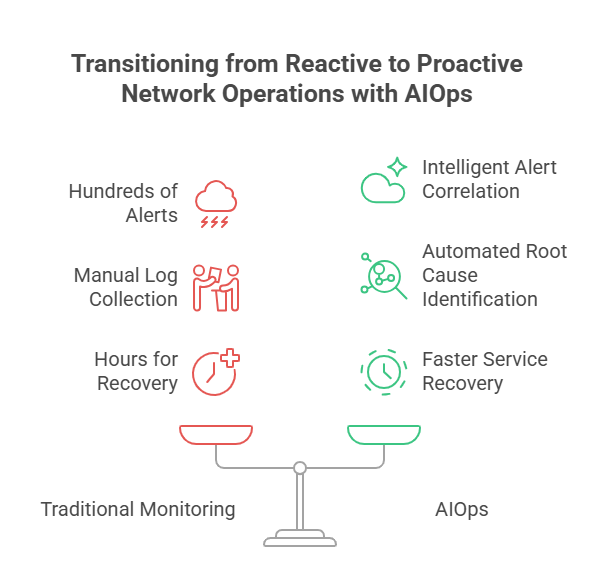
Most organizations already collect large volumes of network telemetry. The challenge is making sense of it quickly enough to prevent an outage. Traditional monitoring platforms generate alerts when something breaks, but engineers still have to determine what happened, assess the impact, and decide how to respond. As environments become more distributed, that manual process becomes harder to sustain, leading many organizations to adopt Autonomous Network Operations that combine AI, analytics, and automation to improve response times and reduce operational effort.
The Growing Challenge of Modern Enterprise Networks
The shift toward Autonomous Network Operations is being driven by the rapid evolution of enterprise IT environments. Today's networks extend across hybrid cloud, multi-cloud, on-premises data centers, branch offices, remote workforces, and multi-vendor ecosystems. While this distributed architecture delivers greater agility and scalability, it also makes Enterprise Network Monitoring far more complex.
It's common for enterprise networks to be monitored through multiple tools, each providing only part of the picture. That often means IT teams switch between dashboards, compare data from different systems, and spend additional time piecing together what is happening across the environment. As a result, teams often encounter:
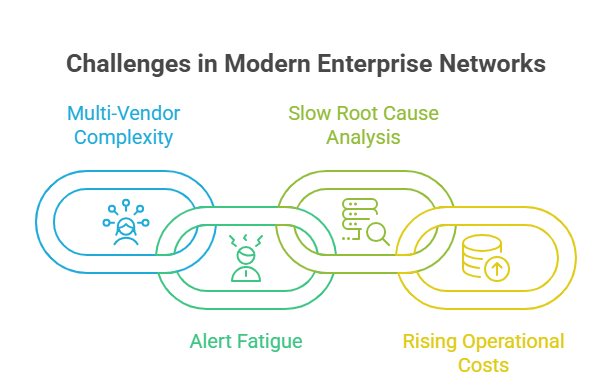
- Multi-Vendor Complexity: Monitoring Cisco, Aruba, Juniper, Fortinet, VMware, AWS, Azure, and other platforms often creates visibility silos.
- Alert Fatigue: Thousands of alerts every day make it difficult to distinguish critical incidents from routine notifications.
- Slow Root Cause Analysis: Engineers spend valuable time correlating logs, metrics, and telemetry to identify the source of an issue.
- Rising Operational Costs: Longer Mean Time To Resolution (MTTR), higher Operational Expenses (OPEX), SLA breaches, and business disruptions directly impact operational efficiency and user experience.
Why Traditional Monitoring Is No Longer Enough
These operational challenges highlight a gap in how many organizations monitor their networks today. Traditional monitoring platforms are good at reporting when something changes, but engineers still have to determine what caused the issue, understand its impact, and decide how to respond.
Most traditional monitoring solutions:
- Detects issues only after users are impacted.
- Generate threshold-based alerts without identifying the underlying cause.
- Require engineers to manually correlate data across multiple tools and dashboards.
- Offer limited predictive intelligence to prevent incidents before they occur.
- Depend on manual intervention for diagnosis and remediation.
The result is a reactive operations model where teams spend more time investigating and resolving issues than preventing them. As enterprise networks continue to grow in scale and complexity, organizations need a more intelligent approach to network operations.
Did You Know?
Cisco found that developers spend more than 57% of their time in war rooms and troubleshooting application performance issues instead of building new capabilities, highlighting how reactive operations continue to drain engineering productivity.
Jade NEXUS: Jade Global's AI-Powered Solution for Autonomous Network Operations
As enterprise networks continue to grow in complexity, organizations need more than traditional monitoring; they need a solution that can intelligently monitor, predict, and respond to network events in real time.
Drawing on more than 15 years of experience helping enterprises modernize complex IT infrastructure, Jade Global developed Jade NEXUS (Network Experience & Unified AIOps System) to help organizations move beyond reactive operations. Combining Enterprise Network Monitoring, AIOps networking, AI-driven analytics, and intelligent automation in a unified command center, Jade NEXUS continuously monitors network behavior, predicts potential failures, identifies root causes, and automates remediation, enabling Autonomous Network Operations and accelerating the shift toward self-healing networking.
How Jade NEXUS Works
Jade NEXUS combines AI for Network Operations with intelligent automation to enable Autonomous Network Operations through four core capabilities:
- Multi-Vendor Telemetry Collection: Collects telemetry from hybrid cloud, on-premises, and multi-vendor environments to provide a unified view of enterprise network operations.
- AI-Powered Analytics: Continuously analyzes network health and performance to predict issues before they impact users, enabling Intelligent Network Monitoring.
- Intelligent Root Cause Analysis: Correlates network events to quickly identify the underlying cause of an issue, reducing manual investigation and accelerating resolution.
- Autonomous Self-Healing: Automatically executes remediation workflows to support self-healing networking, minimizing manual effort and improving network resilience.
Why Organizations Choose JADE NEXUS
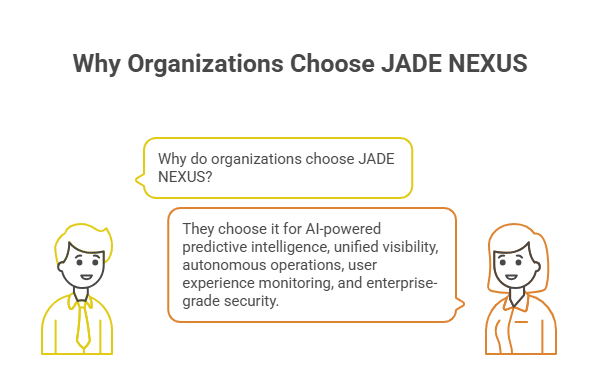
Network operations have become harder to manage as environments grow across multiple vendors, cloud platforms, and locations. Teams need a single operational view that brings together observability, AI-driven intelligence, and automation. That's the role Jade NEXUS is designed to play.
- AI-Powered Predictive Intelligence: Uses AI for Network Operations to identify potential issues before they impact users or business services.
- Unified Enterprise Visibility: Brings together data from multi-vendor environments into a single, intelligent command center for faster decision-making.
- Autonomous, Self-Healing Operations: Automates repetitive operational tasks and remediation workflows to support self-healing networking with minimal human intervention.
- Experience-First Monitoring: Prioritizes digital user experience alongside network health to ensure business continuity.
- Enterprise-Grade Security: Secures operations with role-based access control (RBAC), JWT authentication, secure APIs, and comprehensive audit logging.
Jade NEXUS in Action
Jade NEXUS modernizes AIOps network management by combining observability, AI-driven intelligence, and automation within a unified command center.
From optimizing SD-WAN traffic and identifying routing anomalies to strengthening firewall policies, improving Wi-Fi performance, and securing Cisco ISE access, Jade NEXUS helps organizations reduce manual intervention while improving network resilience and user experience.
Performance Highlights
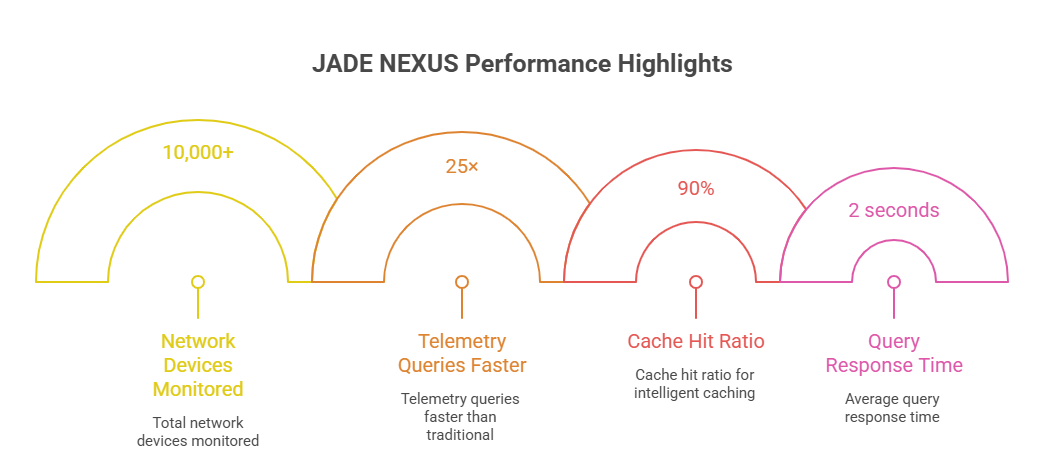
- Up to 25× faster telemetry queries
- 90% cache hit ratio
- Supports monitoring of 10,000+ network devices
- Average query response time of under 2 seconds
- High-availability architecture for mission-critical environments
Business Impact
Jade NEXUS is designed to reduce the operational effort required to manage complex enterprise networks. Based on product benchmarks, organizations can realize:
- Up to 40% lower Network OPEX
- Up to 75% faster Mean Time to Resolution (MTTR)
- Fewer monitoring tools to manage and maintain
- Better SLA performance and network availability
- A more consistent digital user experience
- Lower operational risk through self-healing networking
The Future of Network Operations
Enterprise networks aren't getting any simpler, and operations teams are expected to do more with the same resources. That shift is encouraging organizations to adopt Autonomous Network Operations, using AI and automation to reduce manual effort, shorten investigations, and respond to issues before they grow into larger disruptions.
Built on Jade Global's expertise in enterprise infrastructure transformation, Jade NEXUS (Network Experience & Unified AIOps System) enables organizations to modernize network operations with AI-driven intelligence, automation, and self-healing capabilities, helping IT teams spend less time firefighting and more time driving innovation.
Discover more about Jade NEXUS and know how Jade Global helps enterprises build intelligent, resilient, and autonomous network operations.
Frequently Asked Questions (FAQs)
Que: How is AIOps different from traditional network monitoring?
Ans: Traditional monitoring lets IT teams know when something has gone wrong, but engineers still need to investigate the cause and decide what to do next. AIOps shortens that process by connecting related events, highlighting the likely source of an issue, and supporting faster response through intelligent automation.
Que: Is customer data used to train public AI models?
Ans: No. Customer network telemetry stays within the organization's environment and isn't used to train public or external AI models. Organizations retain control over how their operational data is stored and used.
Que: Can administrators control autonomous actions?
Ans: Yes. Teams stay in control of how automation is used. Some actions can run automatically, while others can be configured to wait for approval before they are executed. Organizations can also decide when rollback is required based on their internal processes.
Que: What are Autonomous Network Operations?
Ans: Managing a modern enterprise network involves much more than responding to alerts. Autonomous Network Operations bring together AI, analytics, and automation to help IT teams identify issues sooner, understand their impact, and streamline remediation. The result is a more efficient alternative to traditional Enterprise Network Monitoring, especially in large, distributed environments.
Que: How does AI improve network monitoring?
Ans: Most IT teams already have access to network telemetry, logs, and events. The real challenge is reviewing that information quickly enough to spot a problem before users notice it. AI for Network Operations helps by finding patterns across that data, highlighting what deserves attention first, and reducing the time engineers spend investigating incidents. This makes Intelligent Network Monitoring faster and more practical in large enterprise environments.
Que: What is a self-healing network?
Ans: A self-healing network uses AI-driven analytics and automation to detect, diagnose, and resolve predefined network issues with minimal manual intervention. Self-healing networking helps improve service availability, reduce downtime, and automate actions such as rerouting traffic, restarting services, or creating ITSM incidents.
Que: What is autonomous network management?
Ans: Autonomous network management uses AI, automation, and AIOps network management capabilities to continuously monitor, optimize, and remediate network operations. It helps organizations simplify complex, multi-vendor environments, improve operational efficiency, and reduce the time spent on manual troubleshooting.
Que: What is Network Operations Center modernization?
Ans: Network Operations Center (NOC) modernization is about giving operations teams the tools to manage today's complex enterprise networks more effectively. Instead of relying only on reactive monitoring, modern NOCs use Enterprise Network Monitoring, AIOps networking, and automation to improve visibility, speed up incident response, and reduce manual operational effort.
Subscribe to our Technology Insights





About the Author

How Can We Help You?
Related Posts