
Beyond “Wi-Fi Is Slow”: From Reactive to Self-Healing Networks with Jade NEXUS
Prerit Bhalani
Aug 21, 2026
Summary: Enterprise Wi-Fi issues are often difficult to diagnose because the root cause can be hidden across multiple network systems and signals. This blog will explain how Jade NEXUS helps simplify this with AI-driven Network Observability and self-healing AIOps and identify root causes faster, automate remediation, reduce MTTR, and improve end-user experience.
It's Never Just "Wi-Fi Is Slow"
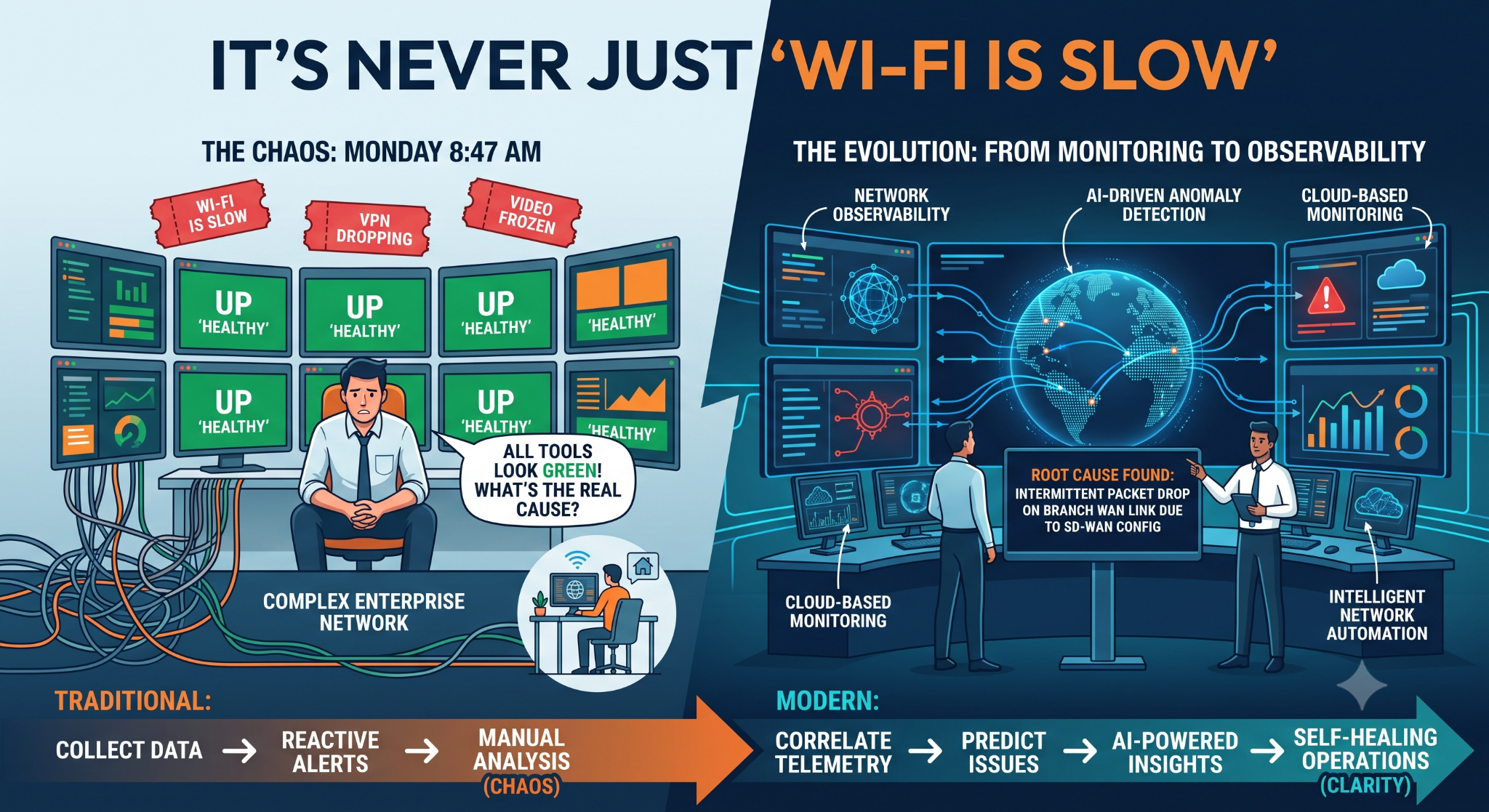
Monday, 8:47 AM. The workday has just begun when the first helpdesk ticket lands in the Network Operations Center (NOC): "Wi-Fi is slow." Within minutes, similar complaints start pouring in; video calls freeze, VPN connections drop, and business-critical applications become sluggish. For employees, it's a simple connectivity issue. For IT teams, it's the beginning of a race against time to uncover the real root cause hidden within an increasingly complex enterprise network.
Network engineers already have access to plenty of data. The difficulty is figuring out what that data is actually telling them. A dashboard might show one thing, while logs or a cloud console point somewhere else. Network observability connects these signals, giving teams a clearer view of what is affecting performance and where the issue is coming from.
Why Enterprise Network Monitoring and Network Observability Matter
Enterprise networks now stretch well beyond the office. They support people working from different locations, cloud platforms, SaaS applications, SD-WAN, IoT devices, and newer AI workloads. Keeping all of this connected and performing well gives network teams a much bigger environment to manage.
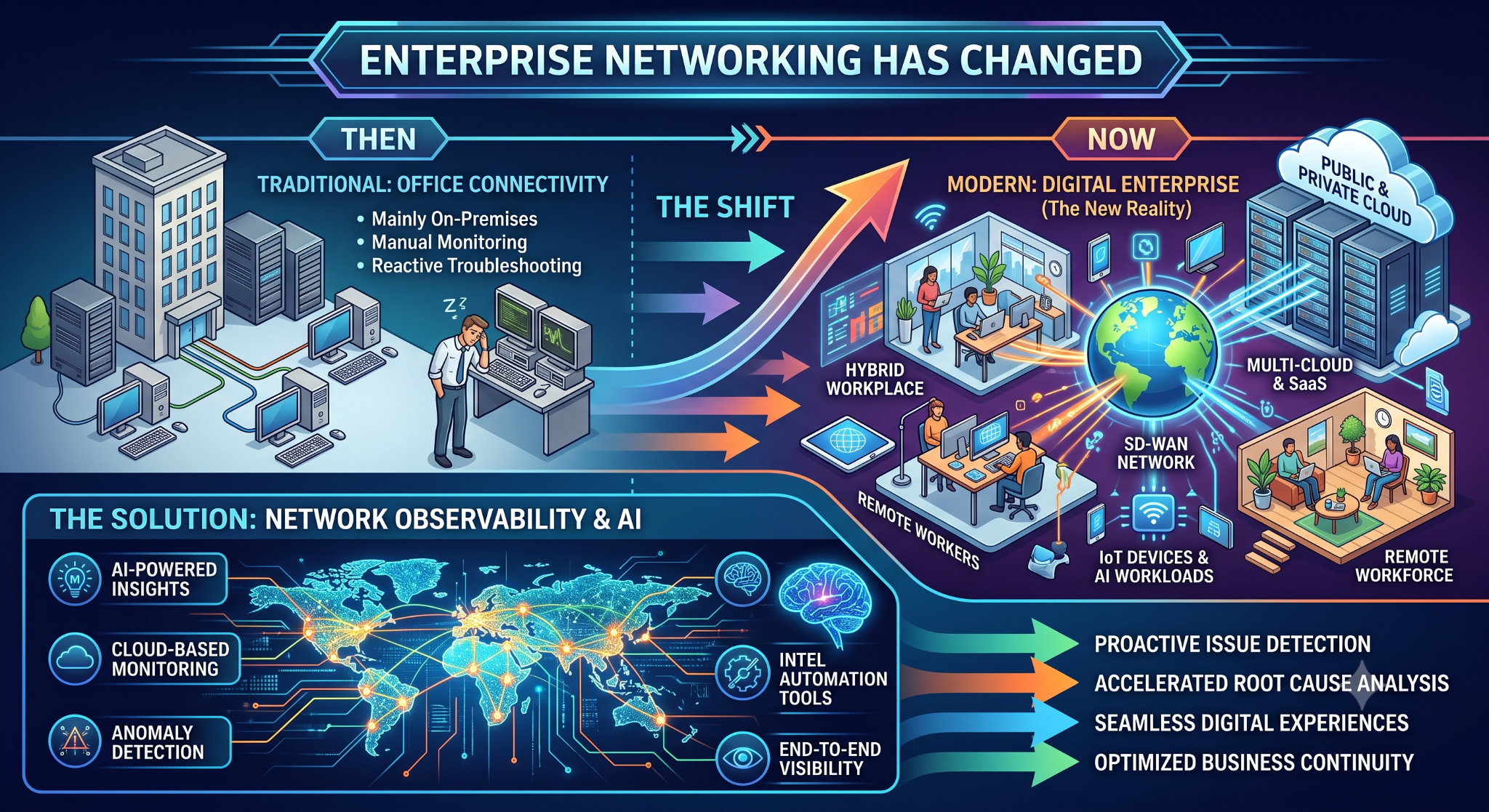
Enterprise network monitoring can show whether devices are up, down, or experiencing performance issues. But that does not always explain what users are experiencing or where a problem started. Network observability adds that missing context by looking at telemetry, logs, metrics, and events together. This gives teams a better way to trace issues, find the cause sooner, and address problems before they lead to wider disruption.
The Hidden Problem Nobody Talks About: Decision Fatigue
The challenge for network teams is no longer getting access to data. It is knowing what deserves attention. With alerts, logs, events, and telemetry coming from different tools and platforms, engineers often spend more time sorting through information before they can begin resolving the issue. Over time, this creates decision fatigue and slows down troubleshooting.
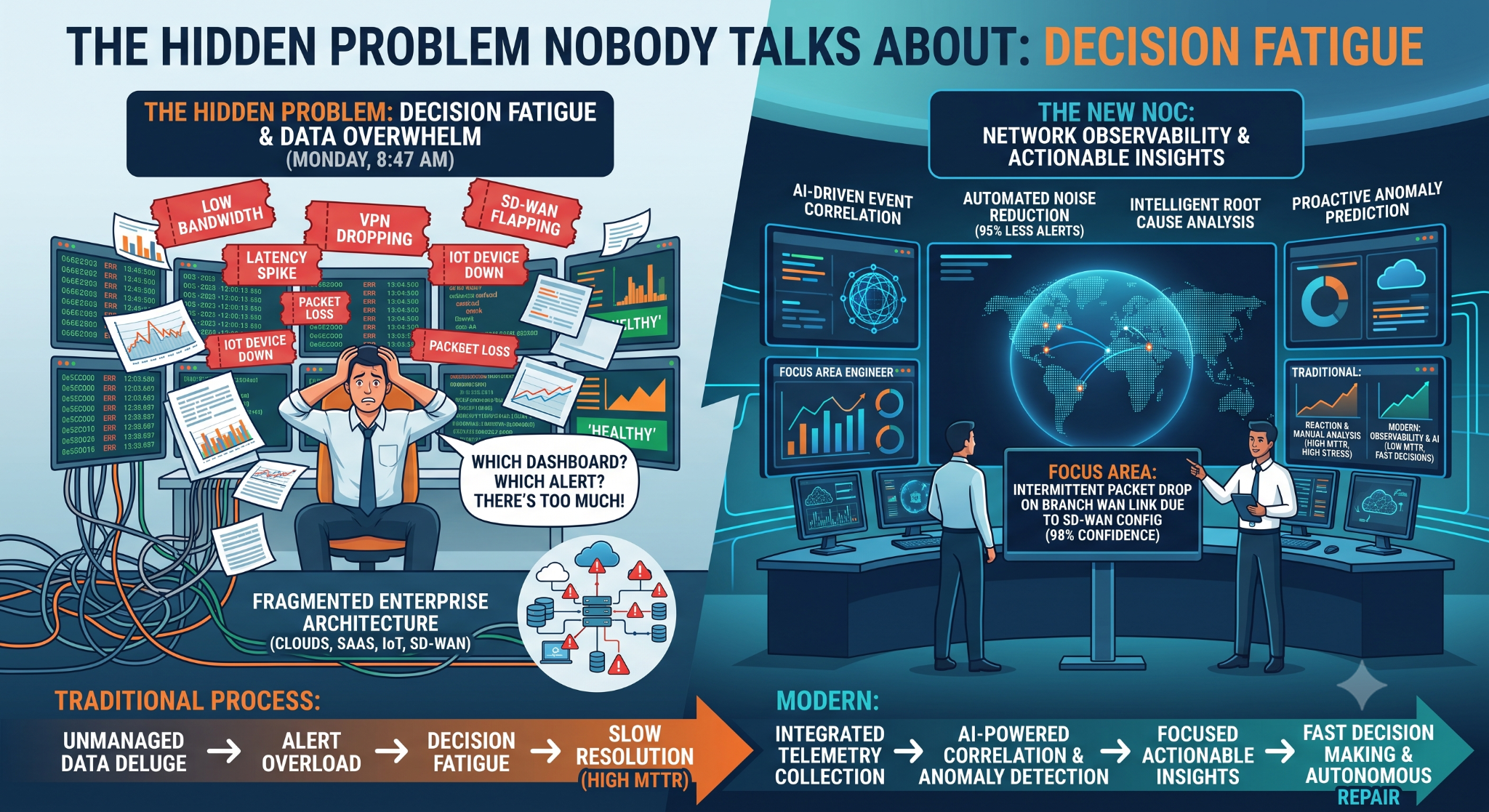
Network observability helps teams cut through this noise by connecting related events and providing the context behind an issue. Engineers can focus on what matters, get to the root cause faster, and improve Mean Time to Resolution (MTTR) without adding more complexity to their day-to-day operations.
From Monitoring to Autonomous Network Operations
Traditional enterprise network monitoring is useful for tracking network health and availability, but today's networks demand more context. With infrastructure spread across hybrid cloud, SD-WAN, SaaS, IoT, and AI environments, knowing that something has gone wrong is only part of the job. Teams also need to understand what caused it, who or what is affected, and how it can be resolved.
Network observability provides that context by bringing telemetry, logs, metrics, and events together. From there, Autonomous Network Operations can use AI to identify patterns, support root cause analysis, anticipate potential issues, and automate corrective actions. This gives network teams a practical path toward faster resolution and more resilient operations.
Bringing Autonomous Network Operations to Life with Jade NEXUS
Modern enterprise networks require more than visibility; they require intelligence. To help enterprises address this growing operational complexity, Jade Global developed Jade NEXUS, an AI-first, cloud-native, and multi-vendor platform that combines Network Observability, AIOps, and intelligent automation to help organizations transition from reactive troubleshooting to autonomous network operations.
Jade NEXUS gives network teams one place to see what is happening across the network, from device health and inventory to client experience, alerts, and performance. It also brings together telemetry, logs, metrics, and events that would otherwise sit across different tools. AI is then used to make sense of those signals, helping teams find connections, trace the source of an issue, and spot potential problems earlier.
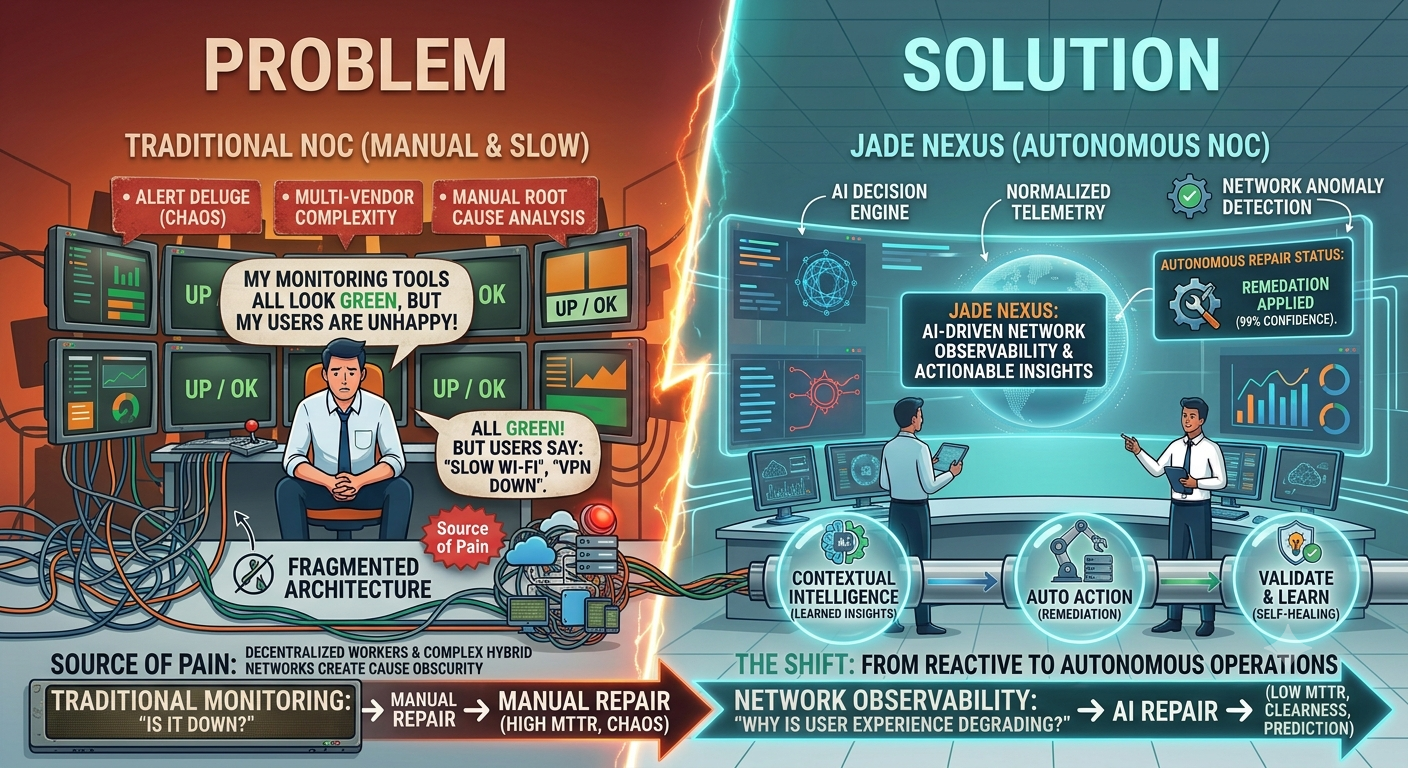
At the core of the platform is a self-healing AIOps engine that follows a continuous lifecycle—Observe → Detect → Correlate → Analyze → Predict → Automate → Validate → Learn. By combining AI-driven decision-making with intelligent automation, Jade NEXUS reduces manual effort, shortens Mean Time to Resolution (MTTR), improves service availability, and enables resilient, self-healing network operations.
AI in Action: Resolving Wi-Fi Experience Degradation & AP Overload with AI-Driven Network Observability Using Jade NEXUS
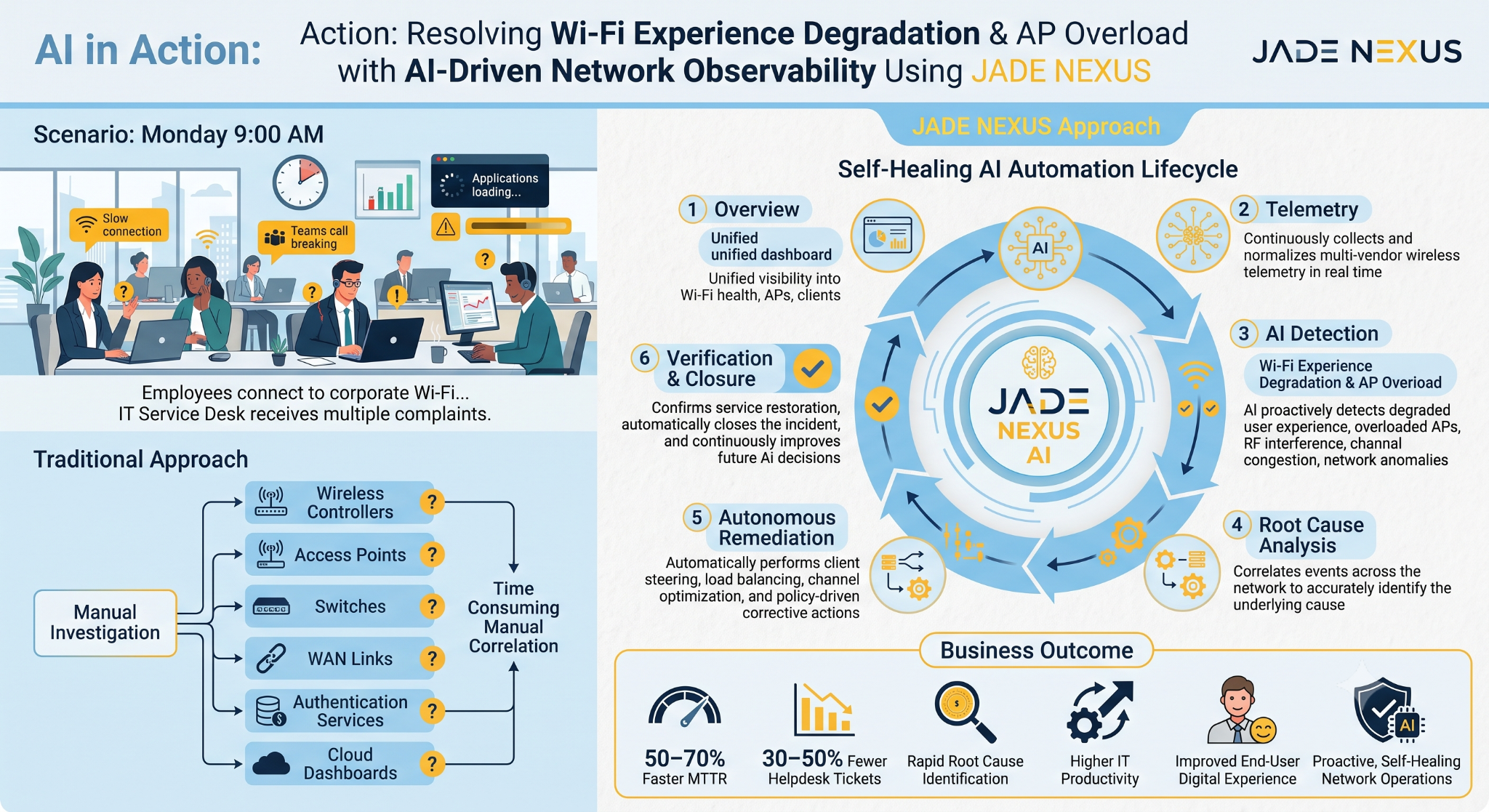
Poor Wi-Fi performance does not always point to one obvious problem. An overloaded access point, RF interference, too many connected clients, or uneven traffic distribution can all affect performance. Finding the source means looking beyond the wireless layer and, in many cases, checking what is happening across switches, WAN links, controllers, and cloud services as well.
Jade NEXUS gives network teams a connected view of these signals. It analyzes network telemetry, links related events, and helps isolate the source of an issue. Based on what it finds, actions such as client steering, load balancing, or channel optimization can be triggered, with the network checked again afterward to confirm the issue has been addressed.
This combination of AI-driven Network Observability and self-healing automation reduces the effort involved in recurring network issues and helps shorten Mean Time to Resolution (MTTR). For IT teams, that means less time spent troubleshooting, better service availability, and a more consistent experience for users.
Business Outcome
- 50–70% Faster MTTR
- 30–50% Fewer Helpdesk Tickets
- Rapid Root Cause Identification
- Higher IT Productivity
- Improved End-User Digital Experience
- Proactive, Self-Healing Network Operations
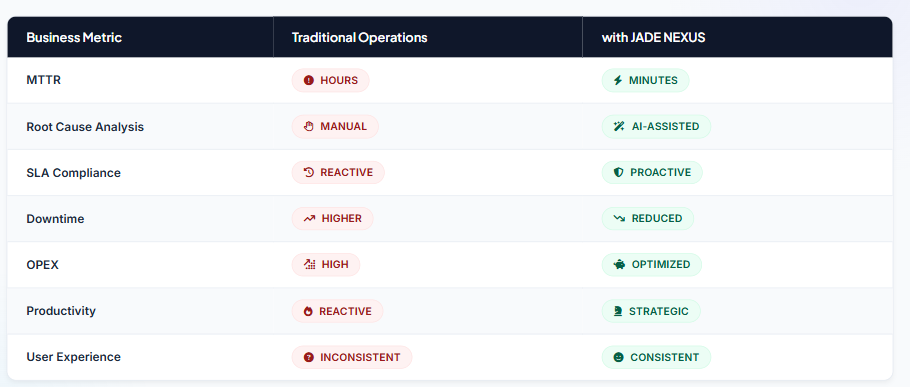
Table: Operational Transformation Map
The Future of Enterprise Networking
Enterprise networks are becoming more automated, and that shift will continue. Technologies such as Agentic AI, Intent-Based Networking (IBN), and Self-Healing AIOps are giving network teams new ways to spot problems early and handle routine fixes with less manual work. This does not take engineers out of the picture. It gives them more room to focus on decisions that need their experience and judgment, while automation takes care of tasks that do not.
Final Thoughts
Traditional monitoring still has its place, but it cannot always explain why a network issue is happening. Network observability, AI-driven analytics, and automation give IT teams more context and help take some of the manual work out of troubleshooting. Jade NEXUS brings these capabilities together, helping teams identify problems sooner and manage network operations more effectively.
Ready to Transform Your Network Operations? Jade Global can help you get more from your network operations with Jade NEXUS, bringing greater visibility, faster issue resolution, and automation where it matters.
Subscribe to our Technology Insights





About the Author

How Can We Help You?
Related Posts