
How to Build an AI-Ready Healthcare Snowflake Data Platform: A Strategic Guide to build Snowflake Data Lakehouse/Mesh for HLS
Debasish Jagaty
May 29, 2026
Key Takeaways:
- Legacy systems limit AI scale, modernization is now a strategic priority.
- Snowflake enables unified, real-time, AI-ready data across the enterprise.
- A DataFirst approach drives faster ROI without disrupting operations.
Why HLS Data Platforms Must Modernize Now
The role of data is changing. It is no longer something teams review after the fact through static dashboards and quarterly compliance reports. Increasingly, it’s something they interact with in the moment-powering real-time decisions across care delivery, operations, and research. This shift is driving the need for a modern healthcare data platform that can support real-time analytics, AI, and governed data access at scale.
Most healthcare and life sciences (HLS) organizations still operate fragmented, batch-oriented data ecosystems built for reporting rather than AI-driven decision-making. Clinical, operational, financial, research, imaging, and commercial data remain distributed across EHRs, LIMS, PACS, claims, CRM, RCM, ERP, and specialized SaaS platforms. Multiple vendors, legacy systems, and M&A-driven duplication further increase complexity.
This fragmented architecture creates major barriers to enterprise AI adoption:
- Fragmented Data Ecosystems: Data exists in silos across clinical, financial, operational, and R&D systems, preventing a unified 360-degree patient, provider, or product view and resulting in incomplete AI training datasets.
- Lack of Semantic Standardization: Partial adoption of HL7 FHIR, SNOMED CT, ICD-10, and proprietary schemas creates inconsistent representation of the same clinical concepts, leading to poor model generalization and unreliable insights.
- Data Quality & Provenance Challenges: Missing, duplicated, conflicting, delayed, and unstructured records combined with weak lineage tracking reduce trust and increase regulatory risk.
- Regulatory & Compliance Constraints: HIPAA, GDPR, FDA, and 21 CFR Part 11 requirements demand explainability, traceability, auditability, and validated AI systems, significantly increasing operational complexity.
- Legacy Infrastructure Limitations: On-premise, batch-driven platforms are not designed for real-time analytics, multimodal AI, or scalable compute workloads, creating latency and operational bottlenecks.
- Weak Governance & Operating Models: Clinical, IT, analytics, and compliance teams often operate independently with inconsistent ownership and governance models, resulting in reconciliation overhead and no trusted single source of truth.
- Unstructured & Multimodal Data Complexity: Notes, PDFs, imaging, genomics, IoT telemetry, and sensor data remain largely unused because they require advanced NLP, computer vision, and multimodal AI pipelines.
- GxP Validation & AI Trust Gap: Regulated environments require deterministic validation while AI introduces probabilistic behavior, slowing enterprise adoption and forcing human-in-the-loop oversight.
- Cost vs. Value Uncertainty: Significant investments in modernization often fail to scale beyond isolated AI pilots, creating “pilot purgatory” with unclear ROAI.
Together, these challenges create four core AI-readiness bottlenecks:
- Data silos that prevent unified enterprise intelligence
- Excessive data movement causing latency and governance risks
- Legacy scalability constraints limiting AI operationalization
- Validation and compliance overhead slowing innovation
The Business Values
Organizations that modernize a modern healthcare data analytics platform typically report
- Organizations that modernize typically report 40–60% reduction in data infrastructure costs
- 3–5x faster time-to-market for new AI and analytics use cases
- 70%+ reduction in pipeline maintenance effort
- 60% productivity improvement in clinical documentation and RCM workflows
- and measurable ROAI within 6–12 months
These reflect outcomes across Jade Global’s multiple modernization engagements in healthcare and life sciences.
AI Use Cases That Modernization Unlocks
A modernized data management platform for healthcare turns analytics from a reporting function into a clinical and operational decision engine, enabling faster decisions, proactive care, and democratized insights across every department.
Here are the use cases that become achievable:
- Healthcare Providers: Ambient AI for automated clinical documentation (reducing after-hours charting by 70%+), real-time patient readmission risk scoring, AI-powered clinical decision support at the point of care, predictive staffing and bed management, and conversational AI patient intake and triage.
- Payers & Health Plans: AI-driven prior authorization automation, intelligent claims adjudication with fraud/waste/abuse detection, predictive member risk stratification for care management, automated appeals letter generation, and AI-powered provider network adequacy analysis.
- Revenue Cycle Management: AI-powered denial prevention and root cause analysis (identified as the top ROI opportunity in 2025 RCM forecasts), automated charge capture validation, predictive A/R aging analysis, intelligent coding assistance, and real-time eligibility verification.
- BioTech & Pharma: AI-accelerated drug discovery and target identification (59% of firms actively using AI for R&D), clinical trial optimization and patient matching, real-world evidence generation from EHR data, pharmacovigilance signal detection, and regulatory submission automation.
- MedTech & Diagnostics: AI-powered medical imaging and diagnostic analysis (71% of MedTech deploying AI for imaging), predictive device maintenance using IoT telemetry, post-market surveillance automation, and AI-driven quality event detection across manufacturing.
- Enterprise-Wide (Across HLS): GxP-compliant predictive validation, automated regulatory reporting, single source of truth knowledge base with conversational AI, natural language data queries for business users, AI-generated pipeline monitoring dashboards, and continuous compliance visibility.
A key principle: AI should empower clinicians and researchers while maximizing ROAI (Return on AI Investments), not automate clinical decisions without human oversight or create uncontrolled spending.
Questions That Reveal Your AI Readiness Gap
To understand why healthcare needs data platform modernization, leaders should ask:
- Can our platform unify EHR, claims, imaging, SaaS, and research data without excessive duplication?
- Can AI models securely access trusted multimodal data in near real time?
- Can governance, lineage, explainability, and compliance operate under a single framework?
- Can AI initiatives scale beyond pilots into enterprise production?
If the answer to most of these questions is “no,” modernization is no longer optional - it is the foundation for becoming an AI-ready healthcare enterprise.
Why Snowflake Data Cloud for HLS
The Snowflake Data Cloud for healthcare and life sciences provides a unified platform to modernize data, analytics, and AI. Managing individual platforms (on-premise warehouse, separate cloud hosting, standalone ML infrastructure, disconnected governance tools) is like trading individual stocks-high maintenance, high risk. A single managed platform like Snowflake is like investing in the S&P 500: the provider handles infrastructure, LLM upgrades, and optimization while you focus on deriving clinical and business value.
Snowflake’s architecture was purpose-built for the cloud. Here is how the two environments compare:
Two Architecture Paths: Lakehouse vs. Data Mesh Reference Architectures
Option 1: Snowflake Data Lakehouse
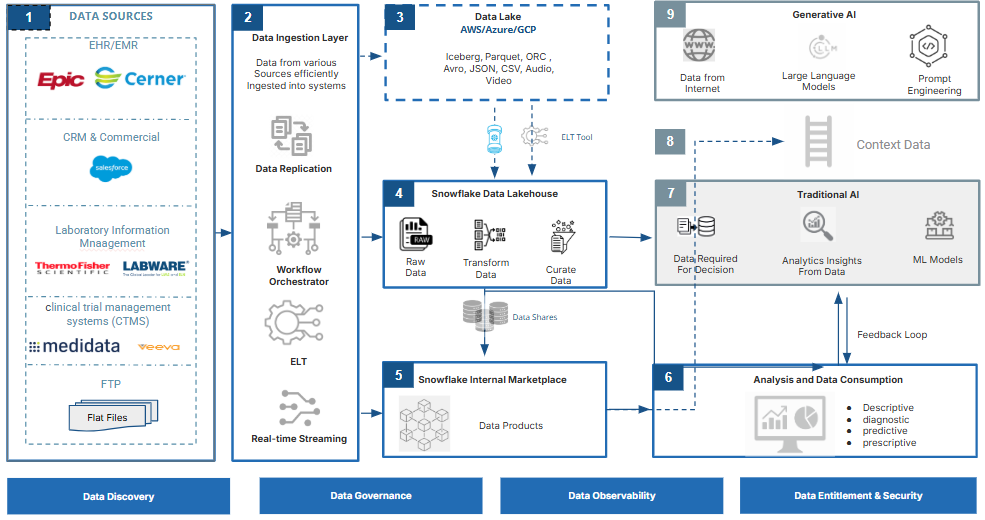
The Lakehouse provides a centralized approach. Data from all HLS source systems-EHR/EMR platforms (Epic, Cerner, MEDITECH), claims adjudication systems, PBM platforms, RCM systems, CTMS, LIMS, PACS/imaging archives, regulatory submission platforms, IoT/medical device telemetry, CRM, and flat files, flows through a unified ingestion layer using Snowpipe and ELT tools, landing as raw data in open formats (Iceberg, Parquet, Avro, JSON, CSV, HL7/FHIR). A workflow orchestrator manages pipeline dependencies through transformation and curation stages. The curated data feeds descriptive, diagnostic, predictive, and prescriptive analytics, with real-time streaming, governance, observability, and data discovery as cross-cutting concerns. Both traditional ML (with feedback loops) and generative AI (LLMs with prompt engineering) operate directly within Snowflake, and an internal marketplace enables enterprise-wide data product sharing.
Option 2: Snowflake Data Mesh
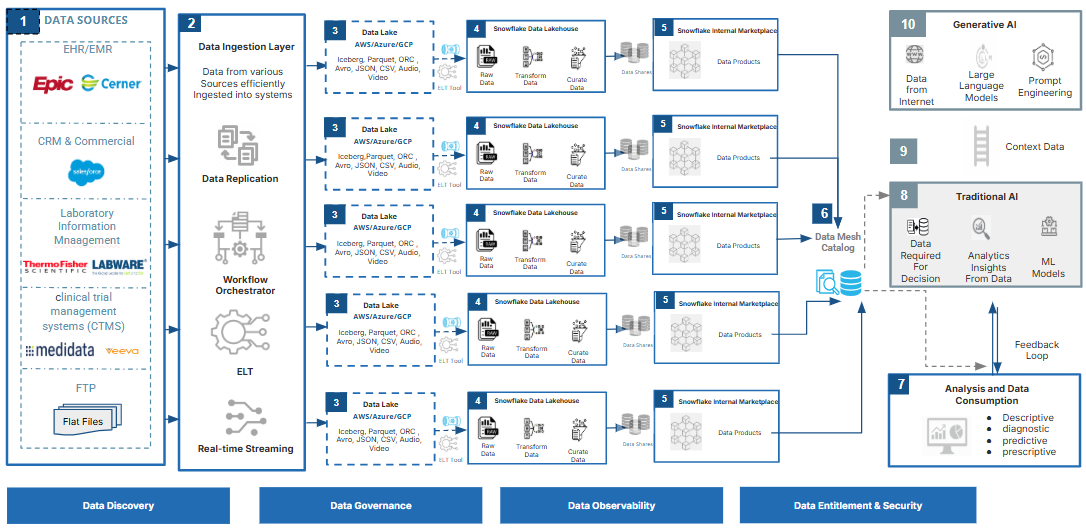
The Data Mesh extends the Lakehouse by organizing ownership around business domains. Each domain (clinical operations, revenue cycle, population health, pharmacy, supply chain, R&D, regulatory, quality) operates its own Snowflake Lakehouse instance with independent raw-transform-curate pipelines. A Data Mesh Catalog provides discovery and cross-domain governance, while domains publish curated data as products through the Snowflake Internal Marketplace, consumed via zero-copy shares. This federated model ensures teams closest to the data own its quality, timeliness, and semantic richness.
The DataFirst Approach and Jade’s Accelerators
The most common AI failure mode is building models on unreliable data. Jade Global’s DataFirst methodology begins with a data readiness assessment across seven dimensions (uniqueness, accuracy, completeness, consistency, outlier management, label quality, and bias), applies AI-powered remediation to reach 95%+ data quality, and only then proceeds to AI implementation. This delivers 3x higher AI project success rates. Jade’s Snowflake-native accelerators compress timelines further:
- SnowPulse AI for account-level cost forecasting and query optimization
- Snowflake PII/PHI Data Masking Accelerator for metadata-driven governance with HIPAA/GDPR/GxP compliance across non-production environments
- Business Activity Lens for real-time clinical and operational workflow analytics
- KYData Advisor, a seven-dimension data quality scoring system delivering 85% faster readiness assessments
- Jade Data Enricher for LLM-powered patient/provider data cleaning and deduplication inside Snowflake Cortex
- GxP Validation Advisor – AI-powered multi-agent platform that automates GxP validation planning and documentation, reducing manual work, cycle time, and regulatory risk across ERP, MES, and QMS systems
- Conversational AI Accelerator for RAG-based enterprise document insight retrieval – 100% native Snowflake solution using Cortex AI, enabling clinicians, researchers, and business users to ask questions in natural language and get trusted answers from governed data
The Path Forward: Modernize Without Disruption
A well-executed modernization program does not disrupt ongoing clinical or operational workflows. Jade Global’s approach uses data replication to maintain connectivity between the existing on-premise warehouse and Snowflake during the transition, allowing progressive workload migration, output validation against the legacy system, and organizational confidence-building before decommissioning legacy components.
HLS organizations with strong centralized data teams may start with a Lakehouse and evolve toward a Mesh as domain ownership matures. Organizations with distributed, domain-aligned analytics teams-common in integrated delivery networks with independent clinical, financial, and research operations, or life sciences companies with separate R&D, commercial, and manufacturing divisions-may accelerate value by adopting the Mesh model from the outset. Regardless, the Snowflake Data Cloud provides the unified platform for storage, compute, governance, AI/ML, data applications, and secure data sharing that HLS institutions need to compete in an AI-driven future.
Ready to Begin Your Modernization Journey?
Start with a free 30-minute Data Readiness Assessment. Our team will evaluate your current architecture, identify quick wins, and outline a phased modernization roadmap tailored to your healthcare or life sciences context.
FAQs:
Q1: What business outcomes can HLS organizations expect from modernization?
Organizations typically see 40–60% infrastructure cost reduction, 3–5x faster delivery of new analytics and AI capabilities, 70%+ reduction in pipeline maintenance effort, 60% productivity improvement in clinical documentation and RCM workflows, and measurable return on AI investment within 6–12 months.
Q2: How does Jade Global ensure modernization doesn’t disrupt clinical operations?
Jade Global uses data replication to run both legacy and Snowflake systems in parallel. Workloads are migrated progressively, outputs validated against the legacy system, and legacy components decommissioned only after clinical and operational confidence is established.
Q3: Is Snowflake secure and governed enough for HIPAA, GxP, and FDA requirements?
Yes. Snowflake provides built-in dynamic data masking, role-based access control, Horizon Catalog for data lineage and discovery, and compliance support for HIPAA, HITRUST, GxP, SOC 2, and 21 CFR Part 11-all managed natively without third-party dependencies.
Q4: What is healthcare data modernization?
Healthcare data modernization is the process of transforming legacy systems into scalable, cloud-based platforms that support real-time analytics, AI, and secure data governance.
Q5: How to modernize healthcare data platforms?
Organizations should adopt a phased approach, starting with data readiness, followed by platform selection, and then progressive migration to a modern healthcare data platform like Snowflake.
Q6: How to ensure HIPAA compliance in data platforms?
Modern platforms like the snowflake healthcare data cloud provide built-in security features such as dynamic data masking, role-based access, and audit trails to ensure compliance.
Q7: What is Snowflake Data Cloud in healthcare?
The Snowflake Data Cloud for healthcare and life sciences is a unified platform that enables secure data sharing, AI-driven analytics, and scalable infrastructure for healthcare organizations.
Subscribe to our Technology Insights



About the Author

How Can We Help You?
Related Posts