Challenges with Siloed AI Agents Built by Enterprise SaaS Providers
Manoj Machiwal
Feb 06, 2025
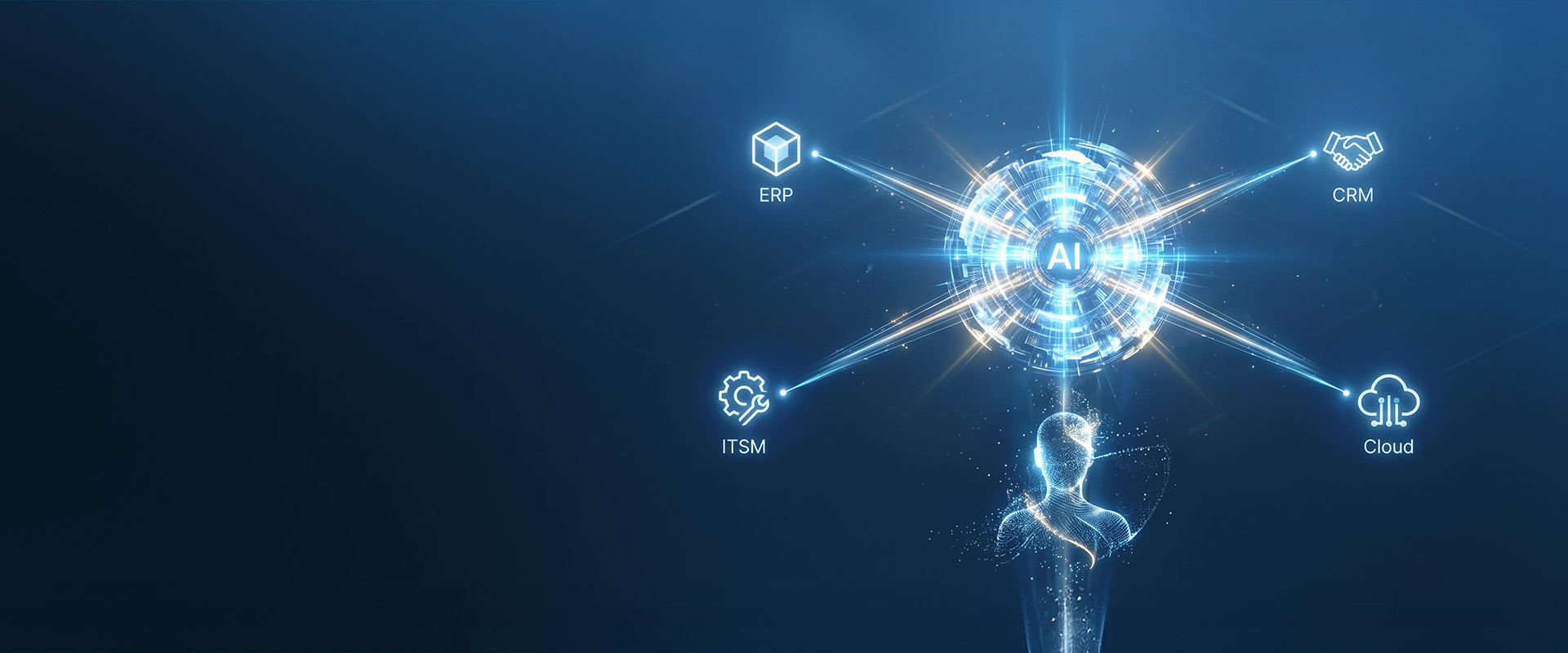
As enterprises increasingly rely on AI-powered solutions within SaaS platforms like Oracle Cloud ERP, Salesforce (SFDC), and ServiceNow, a growing challenge has emerged: siloed AI agents. While these platforms offer powerful AI-driven capabilities, their lack of integration often creates data silos, fragmented insights, and operational inefficiencies.
Businesses striving for AI-driven decision-making, automation, and enhanced customer experiences often struggle with AI agents that operate in isolation rather than as part of a unified enterprise AI solution. Below, we explore the key challenges organizations face when dealing with siloed AI agents across these enterprise SaaS solutions.
Let’s break down the challenges of siloed AI agents across these platforms:
1. Data Fragmentation and Lack of Data Flow
- Challenge: In systems like Oracle Cloud ERP, Salesforce, and ServiceNow, AI agents are often limited to the data within each platform. Oracle Cloud ERP might focus on financial and supply chain data, Salesforce on customer interactions, and ServiceNow on IT service management (ITSM). This creates a data silo problem, where each system's AI agent has access to only a limited subset of the organization's data.
- Impact:
- Incomplete insights: AI agents in each platform can only generate insights based on the data available within their silo. They lack a comprehensive view of the entire enterprise, making their predictions, recommendations, and automation efforts less informed and potentially flawed.
- Reduced actionable outcomes: For instance, Salesforce’s AI-driven sales forecast may not account for supply chain disruptions managed within Oracle Cloud ERP, potentially leading to overestimations of product availability and revenue forecasts.
- Customer experience fragmentation Occurs When Customers interact with multiple AI-driven systems, yet their customer journey remains disconnected without enterprise AI solutions.
- Example: An AI-driven chatbot in Salesforce might recommend an upsell based on past customer behavior, but without integration with Oracle ERP, it may not know that the product is currently out of stock. Similarly, ServiceNow’s AI may lack visibility into CRM data, which prevents it from recognizing critical customer issues that could be flagged for escalation.
2. Inconsistent Decision-Making and Lack of Alignment
- Challenge: Siloed AI agents, each working within their own domain (e.g., finance, sales, IT), may come up with divergent recommendations that are not aligned with the broader organizational goals. This misalignment is common among SaaS service providers, where AI models operate independently.
- Impact:
- Conflicting priorities: For instance, Oracle Cloud ERP might recommend cost-cutting measures in one area of the supply chain, but Salesforce’s AI might push for increased marketing spend to drive more customer leads. Without a holistic view, such recommendations may conflict, leading to inefficiencies and missed opportunities.
- Operational misalignment: AI agents in each system may optimize for different objectives—revenue growth in Salesforce, cost reduction in Oracle ERP, service efficiency in ServiceNow—without understanding how changes in one area impact the other. This misalignment can undermine the overall strategic goals of the organization.
- Example: ServiceNow’s AI may suggest automating IT ticket resolutions to improve efficiency, while Salesforce AI encourages more personalized customer engagement requiring human support. Without integrated AI solutions for SaaS providers, these recommendations clash, reducing productivity.
3. Increased Complexity in Management and Oversight
- Challenge: When AI tools are siloed in platforms like Oracle ERP, Salesforce, and ServiceNow, the management and oversight of these systems become increasingly complex. Each AI agent requires separate monitoring, training, and fine-tuning to align with evolving business needs.
- Impact:
- Resource-intensive maintenance: Teams responsible for managing AI across these systems must ensure each tool remains up-to-date, effective, and compliant. This leads to redundant efforts and increased operational costs.
- Scalability Issues: Siloed AI agents increase the difficulty of scaling AI initiatives across the organization. For instance, scaling predictive analytics for customer service in Salesforce requires a distinct set of models and infrastructure compared to scaling financial forecasting in Oracle Cloud ERP. This fragmentation hinders the ability to scale AI in a coherent and efficient manner.
- Example: The AI model for customer segmentation in Salesforce might need continuous retraining to remain effective. However, if the data pipeline for Oracle ERP is not aligned with Salesforce, the model might miss critical signals such as product availability, pricing changes, or customer payment behavior. Maintaining these disparate models consumes significant time and effort without delivering maximum value.
4. Limited Agility in Adapting to Market or Operational Changes
- Challenge: Without enterprise AI solutions, businesses struggle to synchronize AI-driven insights across departments, leading to delays in adapting to market or operational shifts.
- Impact:
- Delayed responses: For instance, if Oracle Cloud ERP detects an inventory shortage or a delay in production, its AI might not be able to communicate that information in real-time to Salesforce’s AI, which could affect sales forecasts, customer outreach, or lead generation. Similarly, service disruptions identified in ServiceNow may not be reflected in CRM strategies, which can impact customer satisfaction.
- Slow adaptation: AI in siloed systems will struggle to react swiftly to dynamic shifts across multiple domains simultaneously (e.g., supply chain, marketing, and IT). The disconnected nature of siloed AI models means changes in one part of the business may not be reflected across the enterprise in real time.
- Example: A sudden spike in demand detected by Salesforce’s AI (from increased customer interest or promotions) might not be communicated to the ERP or IT systems. As a result, the company could fail to allocate the necessary resources or adjust production schedules to meet this new demand, leading to customer dissatisfaction and lost sales.
5. Security and Compliance Risks
- Challenge: Siloed AI systems in Oracle Cloud ERP, Salesforce, ServiceNow, and similar platforms pose potential security and compliance risks. Each system is likely to have its own security controls, governance structures, and data policies, which can create vulnerabilities.
- Impact:
- Inconsistent compliance: Ensuring compliance with data privacy regulations (such as GDPR or CCPA) becomes much harder when AI systems operate independently. Each system must comply with the relevant regulations for its data, but the lack of integration means an organization may not have a unified view of where sensitive data is being processed, stored, or accessed.
- Increased risk exposure: Security protocols may vary across systems, thereby increasing the risk of data breaches or unauthorized access. The lack of integration also means data flows between systems may not be secure or may bypass necessary controls and audit logs.
- Example: If customer data from Salesforce is analyzed by an AI tool that doesn't comply with GDPR requirements and is then shared with Oracle Cloud ERP for operational forecasting, this could lead to inadvertent non-compliance. Furthermore, sensitive financial data might be exposed due to poor integration between systems.
6. Customer Experience Gaps
- Challenge: A customer issue raised in ServiceNow may not be flagged in Salesforce, leading to delayed resolution. Without enterprise AI solutions, AI-powered experiences remain fragmented.
- Impact:
- Disconnected customer journeys: AI systems in CRM and IT may lack full visibility into the entire customer journey. For instance, a customer may report an issue through ServiceNow’s AI-driven support tool, but the Salesforce sales team may not be aware of it. As a result, the customer might receive conflicting information or experience delays in resolution.
- Missed cross-selling opportunities: The lack of integration between Salesforce and Oracle ERP can lead to sales teams being unaware of customer financials, current product inventory, or shipment status, resulting in missed cross-selling or upselling opportunities that could enhance the customer relationship.
- Example: A customer complaint filed in ServiceNow may not be flagged as a priority in Salesforce's customer engagement pipeline. As a result, the customer may not receive real-time updates on their issue status, leading to frustration and dissatisfaction.
7. High Total Cost of Ownership (TCO)
- Challenge: The costs associated with siloed AI agents in multiple systems like Oracle ERP, Salesforce, and ServiceNow can significantly increase the total cost of ownership (TCO). Each AI solution requires its own infrastructure, maintenance, updates, and integration efforts, all of which can add up quickly. AI solutions for SaaS providers must be designed with integration in mind to reduce redundancies and optimize cost efficiency.
- Impact:
- Duplication of resources: AI tools that serve similar functions in each platform (e.g., predictive analytics, customer segmentation) require duplicate investments in both technology and human resources to manage them.
- Inefficient resource allocation: Disparate AI agents require the organization to dedicate separate resources, both financial and human, to each AI tool. This can lead to inefficiency and higher costs in the long run.
- Example: Oracle Cloud ERP, Salesforce, and ServiceNow may all use separate AI models for forecasting, automation, and optimization, requiring different tools and talent for model development, testing, and deployment. Instead of having a unified AI strategy, the business ends up managing multiple AI silos, increasing operational costs.
Conclusion: The Need for Integrated AI Solutions
To overcome the limitations of siloed AI agents, enterprises must adopt a holistic AI strategy that ensures seamless integration across platforms like Oracle Cloud ERP, Salesforce, and ServiceNow. A unified approach enables better decision-making, real-time data synchronization, and enhanced operational efficiency while eliminating fragmented insights and conflicting AI-driven recommendations.
By leveraging Jade’s AI-Led Managed Services, organizations can establish a scalable, secure, and AI-driven digital ecosystem that enhances agility, reduces costs, and delivers a superior customer experience. The future of enterprise AI lies in breaking down silos and enabling cross-functional collaboration, ensuring that AI truly enhances business outcomes rather than operating in isolation.
Subscribe to our Technology Insights





About the Author

How Can We Help You?
Related Posts