
Exact Match or User Intent? How Databricks AI Search Brings Both Together
How native hybrid search, BM25 keyword matching, and Jade Global’s enterprise execution framework eliminate search friction in the Lakehouse.
Anjali Garg
Sep 07, 2026
Summary: Traditional search architectures often find it difficult to balance exact keyword matches with semantic context, often leading users to abandon their searches. Databricks AI Search combines hybrid retrieval, Delta Sync, and Unity Catalog governance within the Lakehouse. Jade Global helps enterprises modernize legacy search, prepare their data, and scale AI search applications for production.
Imagine a shopper who finds a winter jacket in a store, only to discover that their size is out of stock. They open the app, enter the tag code SKU-9402, and place an order for home delivery. Someone else may be after the very same jacket but search for it as “something durable for a muddy, wet winter run.” Databricks AI Search helps connect these very different queries to the same product; one through an exact code, the other through intent.
If your underlying architecture forces a choice between precise keyword matching and abstract AI meaning, you will lose one of these customers. A keyword-only engine returns a frustrating "0 Results Found" screen for the second shopper's descriptive query, while a pure semantic engine blurs alphanumeric text and recommends the wrong style to the first.
Rushing to build external AI search infrastructure introduces data fragmentation, governance risks, and heavy ETL overhead.
The Legacy Technical Matrix: The "Before" Problem
Maintaining multi-hop pipelines to extract operational data and synchronize it into third-party vector databases creates two critical points of failure:
- Catalog updates don’t always show up right away: A batch sync can leave the search index a step behind changes in price, inventory, or newly added SKUs. So, a product that has just sold out may still turn up in a customer’s search.
- Filtering happens too late: An external vector database may not have the latest operational details, including current inventory. If the application filters results only after retrieval, users can end up waiting for a page that has little, or nothing, to show.
The Native Transformation Blueprint: Reference Architecture
With Databricks AI Search, search stays close to the Delta tables where the data already lives, removing the need for a separate vector database pipeline. Delta Sync picks up changes from Unity Catalog and carries them into the search index, so applications can work with more current data.
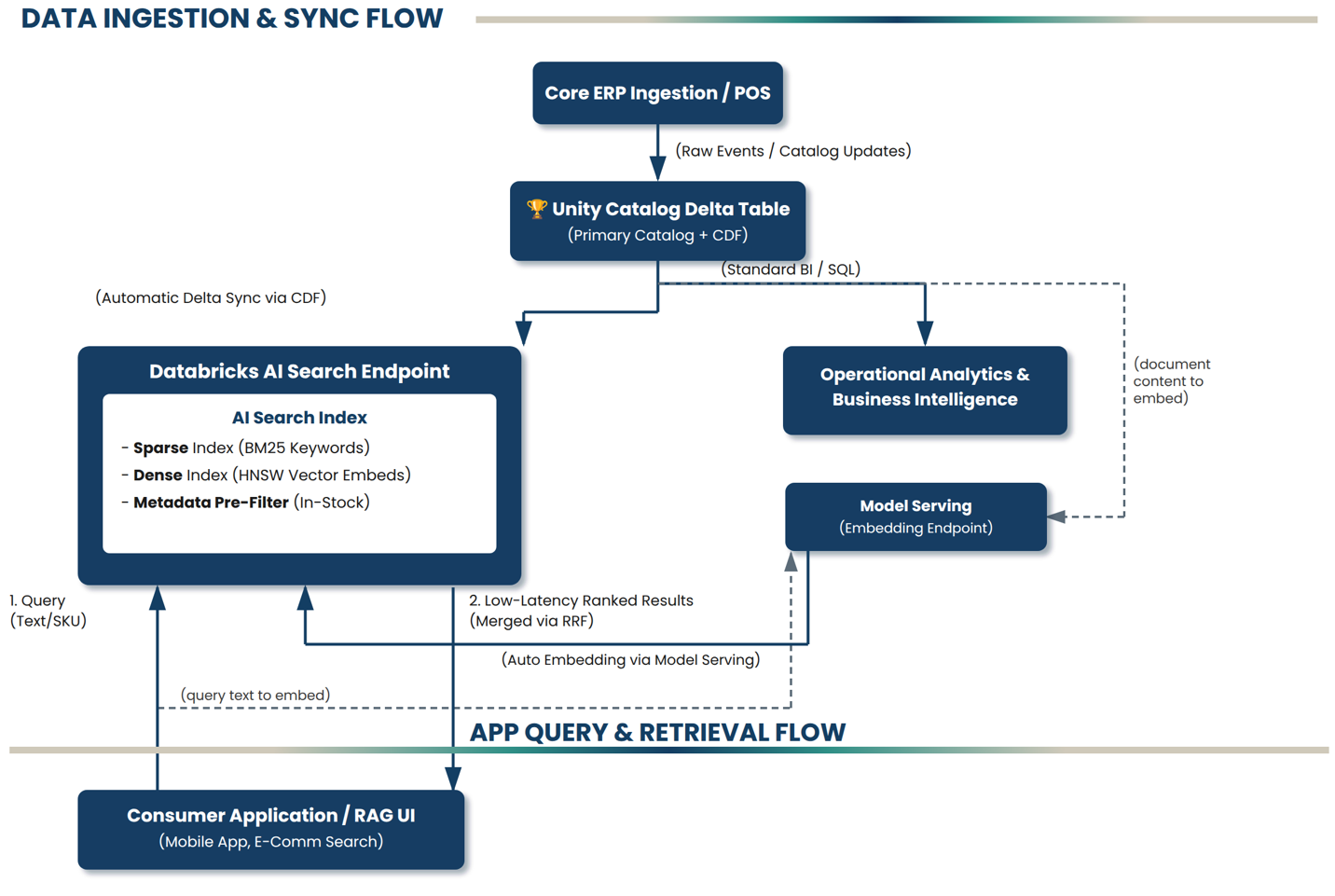
By unifying governance, embeddings, and data sync on a single platform, the system aligns text relevance with business logic at query time.
Resolving the Dual Search Challenge: Hybrid Parsing
Databricks AI Search can run both retrieval approaches through one API call:
- Sparse retrieval (BM25): This path is useful when the query needs an exact match. If someone searches for SKU-9402, for example, BM25 looks for that specific identifier rather than relying on semantic similarity.
- Dense retrieval (HNSW semantic match): Interprets the meaning behind a query such as “muddy, wet winter run” and can surface weather-resistant products even when the query and product description use different words.
The results are then brought together using Reciprocal Rank Fusion (RRF). An exact SKU match can appear first, while useful semantic matches remain close behind. This combination of keyword precision and contextual relevance is one reason Databricks AI Search can support enterprise search experiences where users do not always describe the same thing in the same way.
Operational Matrix: Legacy Friction vs. Databricks AI Search
| Enterprise Operational Vector | Legacy External Search Architecture | Databricks AI Search Resolution |
|---|---|---|
| Catalog & Document Updates | High batch sync latency; updates took hours to reflect in search. | Automatic Delta Sync: Search index refreshes automatically as Delta tables update. |
| Inventory & Business Filtering | Slow post-search application filtering causing empty screens. | Native Metadata Pre-Filtering: Evaluates boolean business filters (in_stock = true) during search scoring. |
| Data Governance & Privacy | Data leakage risks; moving data to 3rd-party DBs stripped access rules. | Unity Catalog Inheritance: Automatically inherits table security, permissions, and ACLs. |
How Multi-Mode Accuracy Drives Conversion & ROI
- Eliminating the "Zero-Search-Result" Wall: Maps conversational intent to conceptual matches, replacing empty result screens with relevant items.
- Avoiding “Ghost Inventory”: Delta Sync keeps search results in step with current warehouse inventory, so customers are less likely to see products that are no longer available.
- Making More of Micro-Moments: Dense vectors can pick up related purchase intent and surface matching gear based on details such as the customer’s size and region.
Beyond Retail: Transforming Search Across Industries
- Healthcare & Life Sciences: Databricks AI Search can be used to find an exact ICD-10 or CPT code and, in the same environment, retrieve relevant information from clinician notes based on context. Unity Catalog provides the governance layer for managing access to that data.
- Financial Services & Wealth Management: A search may begin with something as specific as a ticker symbol or policy ID, or with a broader question that requires finding relevant information across SEC filings and ESG disclosures. Databricks AI Search supports both types of retrieval within the same search experience.
- High-Tech & Manufacturing: Engineers do not always have a part number at hand. They might search for PART-904-X, or simply describe the problem they are seeing in the field. Databricks AI Search can connect both approaches to relevant information in engineering manuals.
Beyond Technology: Where Jade Global Adds Enterprise Value
A Databricks AI Search implementation rarely ends with the search setup itself. Before it can support day-to-day enterprise use, there are practical questions to work through: Is the source data ready? What happens to the existing search stack? Who should be able to retrieve which records? And what will the workload cost once usage grows? Jade Global works through these details with enterprise teams.
- Data readiness and chunking: Databricks AI Search is only as useful as the content behind the index. Text may need cleaning, metadata needs to be consistent, and chunking has to reflect the way users actually look for information.
- Legacy search migration: Elasticsearch, Solr, and standalone vector databases usually cannot be retired overnight. Search needs to remain available while indexes and workloads are moved, which makes the migration sequence important.
- Governance and security: A search should not expose information simply because it exists in the index. Unity Catalog helps carry row- and column-level permissions into the search environment, keeping results within each user’s access boundaries.
- Cost and performance: Sub-second search is useful, but not at any cost. With Databricks AI Search, endpoint capacity and index synchronization can be sized around real query demand instead of provisioning more compute than the workload needs.
For teams looking at the wider production environment, Databricks lakehouse monitoring adds another layer of operational visibility. Together, these considerations form part of a practical enterprise AI search optimization platform strategy rather than treating search as a standalone feature.
Jade Global’s Implementation Framework
Our Intelligent Data Solutions (IDS) practice delivers a proven 4-stage deployment methodology:

- Assess & Strategize: Begin with the current search setup. Look at how the pipelines work today, check the quality and readiness of the data for Databricks AI Search, and define the conversion and ROI measures that matter for the project.
- Architect & Model: Build the hybrid index around the search requirement. This includes selecting an embedding model and configuring Delta Change Data Feed (CDF) to keep the index current as source data changes.
- Integrate & Govern: Expose the search endpoints to applications through low-latency REST APIs, with Unity Catalog controls applied to manage who can access the underlying data.
- Optimize & Scale: Once real workloads are running, tune RRF scoring, test how the system behaves under load, and adjust serverless endpoint scaling. This ongoing work is what turns the implementation into a dependable enterprise AI search optimization platform rather than a search proof of concept.
Accelerate Your Search Modernization with Jade Global
Good search starts with more than the ranking algorithm. The way data, retrieval, and access controls are set up has just as much impact on what users actually find. Databricks AI Search brings those pieces into the Lakehouse, supporting both exact searches and meaning-based queries.
As a Databricks Strategic Partner, Jade Global works with enterprises across Retail, Healthcare, Finance, and High-Tech. That work can start with reviewing an existing search setup, moving workloads from external vector databases, or building a hybrid RAG solution designed for production use.
Ready to eliminate search drop-off in your enterprise? Contact Jade Global today to schedule a personalized Databricks AI Search & Lakehouse Readiness Assessment with our Data & AI experts.
Frequently Asked Questions
Que: What is Databricks AI Search?
Ans: Databricks AI Search brings keyword and semantic retrieval together on Lakehouse data. Databricks AI Search uses Delta Sync and Unity Catalog to keep search connected to current, governed enterprise data.
Que: How does Databricks AI Search work?
Ans: Databricks AI Search combines exact keyword retrieval with semantic vector retrieval. Results from both paths can be ranked together, while Delta Sync keeps the search index aligned with changes in Delta tables.
Que: How does Databricks AI Search support RAG applications?
Ans: Databricks AI Search can retrieve relevant, governed context from enterprise data before it is passed to an LLM. This provides the retrieval layer needed for RAG applications while keeping source data within the Lakehouse ecosystem.
Que:How does Jade Global help with Databricks AI Search?
Ans: Jade Global helps enterprises prepare data, design indexes, migrate legacy search workloads, implement governance, and tune search for production. The focus is on turning Databricks AI Search from a technical implementation into a scalable enterprise search solution.
Subscribe to our Technology Insights




About the Author